Showing posts sorted by relevance for query ode. Sort by date Show all posts

Thursday, November 25, 2021

Poetry Friday, Gratiku Day Twenty-Six, Odes, and a Day After Thanksgiving Roundup: A Cornucopia of Blessings!

I'm hosting Poetry Friday this week, the week of Thanksgiving! Leave your links in the comments and I will round them up, old-school style. I have the day off today, so why not?


I have so much to be thankful for, and I know it even when times are challenging. One of the things I am thankful for this time of year and all the time is poetry. Last year I wrote a whole ode to it, later published in the Birmingham Arts Journal, edited by Irene Latham. (Here's the pdf of the whole issue.) This year a haiku may be all I can manage (although I did try an ode this week too - read on to learn more about it). 


The middle line of today's Gratiku comes from Coleridge's definition of poetry, and in the last line I was thinking of Shakespeare, promising his girlfriend that she would live forever in his verse: "as long as men can breathe, and eyes can see." (I don't really think anything I write will last that long.) See that? Coleridge and Shakespeare in seventeen syllables? Am I an English teacher, or what?


Bounty of poems
(The best words, the best order)
Lines may outlive us.


I read (somewhere) that people were writing odes to autumn for this week, so I decided to try one. I looked up Keats' famous ode, beginning "Season of mists and mellow fruitfulness" (you can read the whole thing here). At first I thought I would try to write a humorous parody, but it ended up not being humorous at all. My first line parodies Keats' first line, and the first line of the second stanza is straight out of his poem. There are a couple of other echoes from Keats, too. (A machann is a merchant, in this case a lady selling fruit by the side of the road. And yes, that conversation mentioned in the poem really happened.)


Ode to Autumn in Haiti, 2021


Season of strikes and utter hopelessness,
No gas, no jobs, no peace, no anything.
Pa gen fig,” says the machann in the street,
Explaining that bananas can’t be bought
Because there’s too much gunfire in the town.

"Where are the songs of Spring? Ay, where are they?"
It seems a while since there was spring-like hope.
It’s always warm, the skies are always blue,
Each gorgeous day has still its music too,
But chaos fills our hearts with suffering.

The tires burn, the smoke spreads out like mist,
The Embassy suggests folks pack their bags --
Well, that suggestion’s for Americans --
And if you’re Haitian, settle in for more,
As autumn turns to winter, one more year:

More scoldings from the countries all around,
More troubles everywhere we turn our heads,
More shortages of all the things we need,
More crime, more heartache, more impunity.
But lovely weather, that we always have.
Yes, lovely weather, that we always have.


©Ruth Bowen Hersey


I did my annual Thanksgiving Odes lesson with my eighth graders. This year I taught it to a few kids sprinkled around my classroom (maintaining distance) and others on the Zoom screen (some faces, but mostly rectangles with their names on them). We watched some YouTube videos of renditions of Neruda odes, then brainstormed a list of possible topics (things for which they were thankful), then went to work. Here are some of their topics: showers, chocolate, boba, soap, Oreos, EDH (city power here in Haiti, often lacking lately), gas (also often lacking lately).  You can see some of their brainstorming in the photo below. (The kids in the room wrote ideas on the whiteboard and the kids Zooming wrote theirs in the chat.) This is one of those assignments almost everyone gets into. It doesn't matter that they don't understand every single allusion in Neruda; they get that he is over-the-top enthusiastic, uses all his senses, and seems to be having a great time. I'm looking forward to reading what they come up with! It's due on Monday, and as I'm writing this, I've only seen one, a fabulous ode to books.


Leave your offerings, whether odes, Thanksgiving fare, or something quite different, in the comments! Comment moderation is enabled, so don't worry if yours doesn't appear right away. I'll get to them as fast as I can!


Margaret moved her weekly "This Photo Wants to Be a Poem" feature from Thursdays to Wednesdays since the last time I hosted Poetry Friday, but I still feel as though it's the beginning of Poetry Friday every week. Check out the locks photo and the responses here to start getting in the poetry mood.


Susan at Chicken Spaghetti shares an absolute delight of a poem, "Not-Yet-Official Girl Scout Badges," by Chloe Martinez. The list of badges is a portrait of an absolute delight of a child. I'm sending this one to my daughter. 


Michelle Kogan has an Ode to Autumn and some beautiful photos from her neighborhood to go with it. She also has an update on her Bearded Iris, if you've been following its story, as I have! 


Kat Apel's post has a cute alert in the title this week, and let me tell you, it's fully justified! Head on over to watch an adorable video of someone reading Kat's book The Bird in the Herd. Kat also left a bird photo just for me - thank you, Kat, for that and your kind words! 


Alan J. Wright has a lovely poem this week about things he's done only once in his life. But I can't help loving his ending best. 


Whenever I host, I like to link to Tiel Aisha Ansari, even though she doesn't participate in Poetry Friday. Her poem about November 2021 from a couple of weeks ago fits in perfectly today.


Sally Murphy has been hard at work on a project that sounds amazing, the Australian Verse Novel Resource. Go and read about it, and how great it's going to be for kids, teachers, and a whole list of others. Bonus: Sally reads from her own verse novel, Pearl Verses the World.


Linda Mitchell is in with an ode to November full of perfect images and leading us into winter in the last line. She also links us to a prayer by her ox friend, Hamish. (I know I'm not the only one who has been enjoying Linda's OLW "Ox" all year long. I'm already wondering what she'll choose for 2022! No pressure, Linda.) 


Janice Scully has a Thanksgiving Mouse for us this week, plus some poems by other people about mice. She's right that mice are popular poetic subjects; I have noticed this before, and I've also noticed that I enjoy these creatures much more in print than in my kitchen -- or my classroom, as has also happened. 


The inimitable Jama is serving soup today on the day after Thanksgiving. She has a wonderful poem, photos, and even a recipe. 


Laura Salas  has an ode to that quintessentially November thing (in northern countries): bare branches. And it's also about what Laura needs these days - and maybe all of us. (If not all of us, at least me.)


I'm loving the odes this week - and here's Linda's at TeacherDance. Yes! She has autumn just right!


I haven't seen anything in the comments yet from Irene Latham, and I know she's had trouble commenting here lately, so I went looking for her post. Sure enough, she's got an autumn poem up, beginning, irresistibly, "We are both nameless -- the trees and me --"...


I totally get what Tricia says today in her comment about how everything she writes these days is about her mom. Her ode to autumn is also an ode to memories of her mother. Lovely, Tricia! 


Margaret, too, was writing about autumn and thinking about a loved person -- in her case, Molly, who lost her father on Thanksgiving this year. It's beautiful, Margaret, and we are so sorry, Molly!


And continuing on the theme of poetry's penchant for being about more than one thing, Sara's ode to making carmels with her daughter made me catch my breath. Favorite words: "she sluices desiccated sunlight." 


Denise is thinking about Ahmaud Arbery, and has a found tanka about Wednesday's verdict. Powerful! 


Heidi dazzles, as always, with her ode that turns out to be also an acrostic! I agree with her assessment of acrostics, both in previous scorn for them and in a growing appreciation for what they can be. I missed her no/de from a couple of weeks ago, and she links to that, too. 


At The Poem Farm, Amy demonstrates personification and invites us to try it. I love her meditation on leaves and goodbyes. 


Mary Lee has an ode to autumn too, and links to an ode to Thanksgiving from yesterday. She also waxes philosophical about what an ode actually is, and I completely agree with her assessment. I love how she shows us various steps in autumn's life-cycle. 


Christie shares a wonderful collaborative poem by her kindergarteners. They are thankful, and so are we! 


Jone has an ode to November that brings out the beauty of what has always seemed to her a sad month. She also has some ideas for 2022: join her in sending out New Year postcards, and buy her new calendar, with photos and poems. It looks bright and lovely! 


Donnetta really needed a break!  (Me too, Donnetta!) She's written a TankaYou about her gratitude for this holiday. 


Carol Labuzzetta has been thinking about music, a "Simple Gift" for which she's grateful. She asks us to consider what our "Simple Gifts" might be.


Carol Varsalona is celebrating a birthday with an ode to autumn, and also by producing the final installment of the Bedecked in Autumn Gallery of Artistic Expressions. She links to five years of previous galleries, too. Such a cool tradition! Happy birthday, Carol! 


Tanita has an ode to autumn that's also about musicians getting ready for a concert. And Tanita is a virtuoso herself, working with rhymes! 


So much beauty this week! Thank you, everyone, for participating! Have a wonderful weekend!


Friday, November 18, 2016

Poetry Friday: Unraveling

This morning I was working on lesson plans on this day off to celebrate the Battle of Vertières, the definitive battle in which the Haitians saw off the French and won their independence.  Next week is Thanksgiving, and I've blogged before on past Poetry Fridays about how I always do odes with my eighth graders for Thanksgiving.  We read Pablo Neruda, and I encourage the kids to write their own odes about things that they love.

I'm very glad Thanksgiving is here; with all the depressing stories in the news, this is an important time to focus on the blessings of life and to thank God for them.  I've posted many of Neruda's odes on this blog, and I'll link them at the end of the post, but today I wanted a new one, so I was looking through my copy of Neruda: Selected Poems, given to me by my daughter (one of my greatest blessings). I found this one, "Ode to the Clothes."  (Here's the whole thing in a different translation from the one I have.)

I've been thinking quite a bit about clothes recently.  I lost a lot of weight in the past year, and most of my clothes are too big for me now.  I have been wearing some oversized things, belting them and feeling ridiculous with the extra fabric, and I have a few clothes that fit my new size perfectly.  I'm hesitant to get rid of the bigger stuff because I am afraid once I do, I'll start gaining weight back.  So I've been contemplating the fate of many garments in my closet, and so far, not doing much about it.

This passage in the poem (Merwin's translation) struck me:

I ask
whether one day
a bullet
from the enemy
will stain you with my blood
and then
you will die with me
or perhaps
it may not be
so dramatic
but simple,
and you will sicken gradually,
clothes,
with me, with my body
and together
we will enter
the earth.
At the thought of this
every day
I greet you
with reverence, and then
you embrace me and I forget you
because we are one
and will go on facing
the wind together, at night,
the streets or the struggle,
one body,
maybe, maybe, one day motionless.

Thinking of the fate of clothes reminded me of a video my daughter sent me earlier this week.  She watched it in her anthropology class.  It talks about what happens to some clothes (100,000 tonnes a year) thrown away in western countries.  It's called Unravel.  What actually happens to the recycled clothes is saved to the very end of the 14 minute video, but in the meantime we hear from the Indian women who do the work, and it's just fascinating to hear the conclusions they have come to about western people from going through their discarded clothes.  Watch all the way to the end: you'll be glad you did!

Have you felt that things were unraveling, this past week?  I have.  In some strange way, this poem and video gave me hope that new things may be made out of changes, whether welcome or unwelcome, and that in spite of everything, I am surrounded by blessings.

Here are some other Neruda odes I've shared in the past:

"Ode to Laziness" in 2012
"Ode to Broken Things" in 2011
"Ode to a Box of Tea" in 2014
"Ode to Life" last year
"Ode to the Onion" in 2013
"Ode to the Lizard" in 2011
"Ode to the Tomato," in 2013
"Ode to the Present" in 2010
"Ode to Scissors" in 2008

Here's today's roundup.

Friday, November 23, 2018

Poetry Friday: Odes at Thanksgiving

Every year I read Neruda odes with my eighth graders during Thanksgiving week, and encourage them to write their own. I've written posts about this several times in the past: here and here in 2010, here in 2011, here in 2012, here in 2013, here in 2014, here in 2015, here in 2016, and here last year.

This year was a little different, because we had a touch of rioting here in Haiti. (Here's an article from the Miami Herald to get you caught up on the situation.) We did have school on Monday, but only four seventh graders and four eighth graders were there. Tuesday we had a delayed start which turned into a day off, and Wednesday we were off again. Yesterday and today were regularly scheduled days off for the Thanksgiving holiday (not a local holiday but we're an American school). So I didn't get to share odes this year, except with the few who were there on Monday; we read "Ode to Scissors," one of my favorites. I'm planning on squeezing a bit more on this into next week's lessons, so we'll see how that goes.

In the meantime, I found a new-to-me ode to share with you for Poetry Friday today. 

Ode to Bird Watching
by Pablo Neruda
translated by Jodey Bateman

Now
Let's look for birds!
The tall iron branches
in the forest,
the dense
fertility on the ground.

...

I bury
my shoes
in the mud,
jump over rivulets.
A thorn
bites me and a gust
of air like a crystal
wave
splits up inside my chest.
Where
are the birds?
Maybe it was
that
rustling in the foliage
or that fleeting pellet
of brown velvet
or that displaced
perfume? That
leaf that let loose cinnamon smell
- was that a bird? That dust
from an irritated magnolia
or that fruit
which fell with a thump -
was that a flight?
Oh, invisible little
critters
birds of the devil
with their ringing
with their useless feathers.

...

I want to touch their gloves
of real hide
which they never forget in
the branches
and to converse with
them
sitting on my shoulders
although they may leave
me like certain statues
undeservedly whitewashed.

...

You can read the whole thing here.


What struck and amused me about this poem is that it isn't an ode to birds; Neruda seems a little vague on the birds themselves. We never get a single concrete bird detail in this poem, and this from a guy who is heavily into concrete details. The subject of the poem is, instead, the experience of bird watching, which appears to be largely frustrating. He's tracking sounds and even smells, asking "Was that a bird?" and anticipating getting pooped on. "Where are the birds?" he wants to know.

I can very much relate to this poem because my own bird knowledge is rudimentary at best (although I'm trying), and my efforts to take pictures of birds result mostly in lovely views of empty branches. And I can relate to it too because I find when I write an ode, or really just about anything at all, it's often as much about me as it is about the topic of my attention.

Neruda wrote about this tendency elsewhere in a poem called "Siempre Yo," or as Ben Belitt translates it, "Me Again."

Me Again
Pablo Neruda
translated by Ben Belitt

I who wanted to talk
of a century inside the web
that is always my poem-in-progress,
have found only myself wherever I looked
and missed the real happening.
With wary good faith
I opened myself to the wind: the lockers,
clothes-closets, graveyards,
the calendar months of the year,
and in every opening crevice
my face looked back at me.

The more bored I became
with my unacceptable person,
the more I returned to the theme of my person;
worst of all,
I kept painting myself to myself
in the midst of a happening.
What an idiot (I said to myself
a thousand times over) to perfect all that craft
of description and describe only myself,
as though I had nothing to show but my head,
nothing better to tell than the mistakes of a lifetime.

Tell me, good brothers,
I said at the Fishermen's Union,
do you love yourselves as I do?
The plain truth of it is:
we fishermen stick to our fishing,
while you fish for yourself (said
the fishermen): you fish over and over again
for yourself, then throw yourself back in the sea.

I've been thinking a lot lately about self-portraits and selfies, and about the idea that we writers are so often our own subject. We're stuck with ourselves, no matter how bored we get. We fish and fish and fish, and throw ourselves back in the sea, and then fish some more. Or we go bird watching and end up focusing on our own experience and missing the birds.

An eighth grader started an ode on Monday, and she passed it to me to look at. It was about her friends, the ones who were there with her at school that day; they were bonding and loving being such a small group. It was an ode to her friends, and an ode to herself with them, the tight little group they formed. I smiled and passed it back to her, telling her she was on exactly the right track.

Irene has this week's roundup.

Thursday, November 26, 2020

Poetry Friday: Thanksgiving, an Ode to Poetry, and Birthday Gifts Edition, #2

This year, I'm thinking about how thankful I am for poetry. In this post, I'll tell you some books of poems. Last week I wrote about one of the books I got for my birthday. This week I'm going to write about three others, and then share an ode I wrote for my Thanksgiving tradition. (Here's last year's ode post, with links to previous ones.)


Camille Dungy's website calls her book Smith Blue "a survival guide for the modern heart."  The poems are about, as Dungy puts it in "Daisy Cutter," "the world we have arranged," the mess we've made of it all. 


I wrote a little bit about Agha Shahid Ali's book A Nostalgist's Map of America here. Ali writes about deserts of all kinds, from his original home in Kashmir, to South America, to the American west. It's hard to find anything short to quote, because it's all part of the whole, but here's one of his poems (not from this book), and Poetry Foundation has several more, too. 


I also received Ten Poems about Art, selected and introduced by Geoff Dyer, a wonderful selection of ekphrastic poems. 


Every year I read odes at Thanksgiving with my eighth graders, and we write them, too. This year I shared Neruda's "Ode to an Apple," which seemed to fit with the book we're reading, The Giver. I also shared "Ode to Subway," an ode by a middle schooler included in Nancie Atwell's anthology Naming the World. And here's the one I wrote this year:


Ode to Poetry


You have words to say it all,
Poetry,
even what can’t ever be said.

I read you or write you
when I’m happy,
or when I can’t bear it any more.
Sometimes I send you to others,
and sometimes I clutch you close,
keep you all to myself.

You’re filled with nouns:
flowers and dust,
onions and garlic,
American redstarts
and emptiness.

You’re filled with verbs:
snack and giggle and rest,
yearn and caress and lose,
blurt,
dream and wake and
love.

You’re filled with moments:
an afternoon in Paris,
feeding pieces of schwarma to the pigeons;
a morning in Port-au-Prince,
watching tires burn;
bath time,
soothing a baby in warm sudsy water.

You are deep and wide,
like a steamer trunk I’m packing for an ocean voyage,
or like the ocean itself,
stretching endlessly into the horizon,
with room for complications.
With room for all of it.
 

Ruth, from thereisnosuchthingasagodforsakentown.blogspot.com 


It occurs to me on Friday morning that I ought to add - the American redstart is not some kind of political reference, but a beautiful little black and orange migratory bird that visits my yard this time of year. I wrote him his own poem, plus there's a photo, here.


I took this picture in Jacmel almost a year ago - the last time I was at the beach.

Friday, November 23, 2012

Poetry Friday: Pablo Neruda and Coldplay, Together at Last

I like to read and write Odes around Thanksgiving (here's last year's), so for today, the day after Thanksgiving:


Ode to Laziness
by Pablo Neruda
translated by W.S. Merwin

Yesterday it seemed
the ode wouldn't leave the ground.
It was time, it should
at least show a green leaf.
I scratched the earth, 'Get up,
sister ode
- I said to her -
I've promised you,
don't be afraid of me,
I'm not going to chew you up,
ode with four leaves,
ode for four hands,
you'll take tea with me.
Rise,
I'll crown you among the odes,
we'll go out along the shore
of the sea, on a bicycle.'
No use.

Then
high up in the pines
laziness
appeared naked,
I got up in a daze,
half asleep,
on the sand I found
little broken fragments
of oceanic substances,
wood, seaweed, shells,
feathers of sea birds.
I looked for yellow
agates but found none.

The sea
filled the spaces,
wearing away towers,
invading
the coasts of my homeland,
pushing forward
successive catastrophes of foam,
Alone on the sand
a ray opened
a ring of petals.
I saw the silvered petrels
pass, and like black crosses
the cormorants
nailed to the rocks.
I set free
a bee dying in a spider's web,
I put a little stone
in my pocket,
it was smooth, very smooth,
like a bird's egg,
meanwhile on the coast
all afternoon
the sunlight and cloud wrestled.
Sometimes
the cloud was filled
with light
like a topaz,
other times a moist
ray of sunlight fell,
and yellow drops fell after it.

At night
thinking of the duties of my
fugitive ode,
I took off my shoes by the fire,
poured the sand out of them
and almost at once fell
sound asleep.

Somehow the combination of the ocean and yellow and the fugitive ode and the somewhat melancholy mood that is on me today made me think of this song.  I wonder if Coldplay and Pablo Neruda have been combined before.


Here's today's Poetry Friday roundup.

Friday, November 25, 2011

Poetry Friday: Ode to Broken Things

I always do odes with my eighth graders during Thanksgiving week. I think odes go wonderfully with Thanksgiving, when we are so aware of the huge list of our blessings. We read some examples from Neruda and from students, and I encourage them to write their own. Some people always do. I told you about this last year.

This year as we were reading some Neruda, I noticed this one, "Ode to Broken Things." I've been feeling a bit like a broken thing myself lately. I'm all repaired and glued together, but I'm aware of the fixed places, and I don't think I'm the same as I was before.

This translation is done by George Schade, and is from the book Fifty Odes. Here's Jodey Bateman's translation. I don't read Spanish, so I can't comment on which is more accurate. I like both of them.

This Thanksgiving, I'm thankful for all the broken things in my life and for the way God makes them into something new, something not the same as before, but still beautiful.


Ode to Broken Things

Pablo Neruda, tr. George Schade

Things are being broken
in the house
as if pushed by an invisible
voluntary breaker:
it's not my hands
or yours
or the girls
with tough nails
and earthshaking footsteps:
it was nothing, nobody,
it wasn't the wind,
or the tawny noon,
or the terrestrial night,
it wasn't nose or elbow,
the swelling hip,
ankle
or gust of air:
the plate broke, the lamp fell,
all the flower vases crumbled
one after another, one
in full October
brimming over with scarlet,
worn out by all the violets,
and another empty one
rolled, rolled, rolled
through the winter
until it became
just flower vase gruel,
a broken memory, luminous dust.

And that clock
whose sound
was
the voice of our lives,
the secret
thread
of our weeks,
which one by one
tied up so many hours
to honey, to silence,
to so many births and travails,
that clock fell too
and its delicate blue
viscera vibrated among
the broken glass,
its long heart
uncoiled.

Life grinds away
glass, wearing out clothes,
tearing to shreds,
crushing
forms,
and what lasts in time is like
an island or ship at sea,
perishable,
surrounded by fragile dangers,
by implacable waters and threats.

Let's put everything once and for all, clocks,
plates, glass carved by the cold,
in a sack and take our treasures out to sea:
let our possessions crumble
in a single alarming breaking place,
let what is broken
sound like a river
and let the sea reconstruct
with its long toiling tides
so many useless things
that nobody breaks
but which got broken.


Here's some more Neruda I've posted in the past: "Ode to the Lizard," "Ode to the Present," a bit from "Ode to Scissors," "Goodbyes," and a bit of "To the Dead Poor Man." I love Neruda.

Today's Poetry Friday roundup is here, at My Juicy Little Universe.

Thursday, November 28, 2019

Poetry Friday: Ode to my Work

Every year I read Pablo Neruda odes with my eighth graders around Thanksgiving. Here's last year's ode post, with links to other ode posts, and odes, from every year since 2010. Of course, this year I'm teaching my students over the internet because of Haiti's unrest, but that doesn't mean we can't read and write odes. I sent them some links to ode videos on YouTube, like this one:
and this one:


I suggested they choose something to write about that they really, really love. And then I tried to do the same. As I'd advised my students, I made a list of things I was thankful for, things I really, really love. And I kept coming back to teaching, and my job, and, well, them. Those students.

Here's my first draft. Their first drafts are due tomorrow, so I've only read one so far, and I can't wait to read the rest.


Ode to my Work (first draft)

Work to do,
problems to solve,
a place to belong:
my job.

A paycheck is good,
but oh, Work,
you are so much more to me than that.
On days when burning barricades
keep me from you,
how I miss you!

I miss greeting my students,
learning their language,
finding ways to reach them.
I miss the conversation.
I miss the words:
the books we read together,
the mentor texts,
the new vocabulary.

I miss school lunch,
break duty with my whistle hanging around my neck,
meetings with my colleagues,
managing my classroom library.

I miss creating my lesson plans,
planning how I want the time to go.
Of course,
sometimes it doesn’t go
exactly the way I had in mind,
but that’s the best part,
adapting and adjusting,
explaining it a different way,
figuring out how to make it work.

Figuring out how to make it work, Work,
that’s what I love about you.

I miss stepping into my room,
a room to which I have the key,
a room with my name on the door,
a room I set up,
a room with my handwriting on the board,
my fingerprints everywhere.
I miss the me-shaped space.

Ruth, from thereisnosuchthingasagodforsakentown.blogspot.com

When I wrote "I miss the conversation," I meant the literal conversation with my students, but I also meant the Great Conversation, and our little part in it. But of course, that Conversation goes on. I'm inspired by Neruda (by way of Nancie Atwell), and last week my poem about the ovenbird, inspired by the bird itself (by way of Robert Frost) and illustrated by a photo from eBird.com, inspired Michelle Kogan to create this wonderful picture, which she posted on Facebook one day last week as a greeting to all her friends with a birthday that day (and which she graciously granted me permission to post here, also):


Here's this week's roundup, all the way from Switzerland.

Friday, November 24, 2017

Poetry Friday: Odes

Welcome to my traditional annual Poetry Friday post on odes.  Here's last year's, with links to others.  I always do odes with my eighth graders during Thanksgiving week.  This year we looked at Pablo Neruda's Ode to a Tomato, Ode to Scissors, and Ode to a Hummingbird.  We talk about the ecstatic, over-the-top quality of these poems, and we brainstorm a list of possible topics of our own.


This is last year's list - I forgot to take a picture of this year's.  There is some overlap from year to year, but also lots of quirky originality.  This year one girl said "bras," and while I'm pretty sure she was trying to be shocking, I put it on the list, because well-fitting underwear is definitely ode-worthy.

So here's one I found this year, in my copy of Five Decades: Poems 1925-1970, by Pablo Neruda (this is a bilingual edition, with facing page translations into English by Ben Belitt).  It seems appropriate for several reasons.


Ode on Ironing

Poetry is white:
it comes out of the water covered with drops,
it wrinkles and piles up in heaps.
We must spread out the whole skin of this planet,
iron the white of the ocean:
the hands go on moving,
smoothing the sanctified surfaces,
bringing all things to pass.
Hands fashion each day of the world,
fire is wedded to steel,
the linens, the canvas, coarse cottons, emerge
from the wars of the washerwomen;
a dove is born from the light
and chastity rearises from the foam.


This year I am thankful for many things, but one of the greatest is writing: writing that I do, and writing that I read.  I'm thankful for novels and poetry; for thank-you notes; for my students' writing prompts, sitting in a heap on my floor waiting for me to grade them (OK, I'm not as thankful for those).  I'm thankful for my Quinquagenarian Writing Project.  I'm thankful for the way writing helps us smooth out the sanctified surfaces, figure out our lives, make the miserable parts bearable and the beautiful parts longer-lasting.  Anne Lamott writes, "My gratitude for good writing is unbounded; I'm grateful for it the way I'm grateful for the ocean. Aren't you?"  Yes, I really am.  

I'm looking forward to reading posts from this week's roundup, hosted by Carol at her corner.


Friday, June 29, 2018

Poetry Friday: Bayou Song Blog Tour

Today I am honored to host the third stop on Margaret Simon's Blog Tour for her charming new book Bayou Song: Creative Explorations of the South Lousiana Landscape (you can see a list of the other stops on the Tour at the end of this post).  When I read the book, I had just listened to this podcast from On Being, so those two pieces of art, both about finding joy in nature, are intertwined in my thoughts.

Let me back up a little bit and tell you about one of the ideas in the podcast, and how it illuminated Margaret's book for me and made me appreciate even more the beautiful way it mixes nature, reading, and writing.

In the podcast, Krista Tippett interviews Michael McCarthy, the British author of The Moth Snowstorm: Nature and Joy.  She starts out by sharing this quote from McCarthy: "The sudden passionate happiness which the natural world can occasionally trigger in us may well be the most serious business of all." He has a lot to say about crisis in the natural world, the way ecosystems are collapsing, habitats are disappearing, and there are just fewer creatures out there.  It would be easy to despair, and sometimes when we teach kids about nature we can do it in a negative way, focusing on words like "endangered."

Tippett says to McCarthy: "while statistics of decline and demise and the destruction of the natural world don’t mobilize action — they, in fact, dampen us — and so joy can have a quality of seriousness, and yet, be animating."

And he replies: "If we could mobilize this sort of love we have for the natural world — and the essence of it is the fact that the natural world is a part of us, and that if we lose it, we cannot be fully who we are. And if we were to realize that, which is hard, and if we were to realize it on a large scale, which is even harder, that might offer a defense of nature at the time when we are trashing it remorselessly."

As I was listening to this interview, I was thinking about how we can do this with children; how can we encourage them to love the natural world so much that they want to protect it, not out of fear and despair, but because it's so important to them?

When I read Margaret's book, I thought: this is how. 

In Bayou Song, Margaret doesn't write about the whole world. She writes about her tiny part of it, a part that she loves, a part on a bayou in Southern Louisiana. Using a variety of forms, she writes loving tributes to plants and animals that live where she does. Beautiful photography and drawings help the reader see Margaret's world even more clearly. And then each poem is accompanied by a prompt, so that we, following Margaret's lead, can look around closely at the nature in our world.  What lives where we do?  Let's pay attention, and let's write about it!

Here's an example of Margaret's writing, "Ode to a Toad."

Her note introduces the reader to Pablo Neruda and his odes to ordinary things. She suggests writing an ode, too. So I did. I looked around my part of our beautiful planet, a street in the suburbs of Port-au-Prince, Haiti.  Look what's in bloom right now!
Taking Margaret's poem as my mentor text, I wrote my own ode.  (The "conspicuous claws" reference comes from a little research I did, in which I learned that the word "delonix" comes from Latin for "conspicuous claws," a description of the petals of this tree.)


Ode to a Flamboyant Tree (Delonix regia, Royal poinciana)

You blare
your bright red jazz
through June’s steamy days.
You are all flourish
and ostentation.
Leaving subtlety
to others,
you make the most
of your conspicuous claws.
You accessorize your red
with glowing flashes
of yellow and white. 
Royal tree,
I curtsy to you as I walk by.
I watch you fan yourself
with your green fringes
and display your blossoms
to advantage.
Flamboyant you are
as you dance
with your castanets,
far into the night.

by Ruth, from thereisnosuchthingasagodforsakentown.blogspot.com


How can we encourage kids to care for nature? We can encourage them to love it, and we can do that by teaching them to pay attention to it, not as a grand abstraction but in the specific plants and animals around them. Margaret's poems and prompts will help me do that with my students next year.

Order your own copy of Margaret's book here.

Bayou Song Blog Tour

To read more exciting posts about Margaret Simon’s debut children’s poetry book, Bayou Song, follow this blog tour.

Friday, June 22: Michelle Kogan
Tuesday, June 26: Catherine Flynn at Reading to the Core
Friday, July 6: Kimberly Hutmacher at Kimberly Hutmacher Writes
Friday, July 13: Linda Mitchell at A Word Edgewise
Tuesday, July 17: Laura Shovan
Tuesday, July 24 Amanda Potts at Persistence and Pedagogy
Friday, July 27: Carol Varsalona at Beyond LiteracyLink
Monday, July 30 Linda Baie at Teacher Dance
Friday, Aug. 3 Dani Burtsfield at Doing the Work that Matters

Carol has today's roundup.

Friday, November 21, 2014

Poetry Friday: Odes

I always do odes with my eighth graders at Thanksgiving.  I think I've started about four posts with that sentence so far on this blog.  (Here are my previous ode-related posts.)  We read several examples, and some of them write one. 

Here's a wonderful one, Ode to a Box of Tea, by Pablo Neruda.  It starts like this:


Box of tea
from
elephant country,
now a worn
sewing box,
small planetarium of buttons:
you brought
into the house
a sacred,
unplaceable scent,
as if you had come from another planet.

You can hear my brother reading the whole thing here.  

If you need some odes and don't have any Pablo Neruda books on hand, here's a link to a nice pdf collection you can start with, including the full text of the Ode to a Box of Tea:  Odes.

Why not write an ode to something you're thankful for?  And check out today's Poetry Friday roundup.

Friday, November 26, 2010

Poetry Friday: Ordinary

On Sunday I mentioned that we would be reading odes in eighth grade this past week. We did, and a couple of kids tried one: I got an ode to water and an ode to chocolate. Good topics. When I started to write my own, though, I couldn't narrow down my thoughts to one object, so I ended up writing an ode to ordinary.


Ode to Ordinary

Praise the tedium of an ordinary day.

Getting up in the morning,
Spreading butter on bread,
Dishes to wash and laundry to fold,
Bickering children with beautiful, dirty faces.

Meetings and emails,
Papers to grade,
Sticky notes and dust.

The regular faces, the regular greetings,
Good moods and bad,
Grumbling about the weather.
Beans and rice for lunch on a green plate.

The sun came up today.
The earth is not quaking under my feet.
I am not in pain.
Dress up and use the good china!

Praise, praise the tedium of an ordinary day.

Ruth, from thereisnosuchthingasagodforsakentown.blogspot.com

Here's today's Poetry Friday roundup.

Wednesday, November 23, 2022

Poetry Friday: Ode to Neruda's Table and Mine, and the Roundup is Here!


When I signed up to host Poetry Friday back in June, I wasn't even sure what country I'd be living in by November. But I knew that Thanksgiving would be a time when I'd be thinking about odes, and that's why I chose this date. As it turns out, the school where I work now in Uganda doesn't have a Thanksgiving break, since a very small percentage of our constituency is from the United States. And more unexpected, I'm now not even teaching English, so I won't be writing odes with kids this year. I'm back to my original subject, the one I got degrees in: French. 


It's still a great time to host Poetry Friday. I'm pretty sure I was the first person to host Poetry Friday from Haiti, and then the first from Paraguay, and now the first from Uganda.


Welcome to the roundup, friends! Leave your link in the comments, and I'll round them up the old-fashioned way. My time zone is eight hours ahead of Eastern time, so it's going to be well into Saturday for me before this Poetry Friday is over. Bring it on!


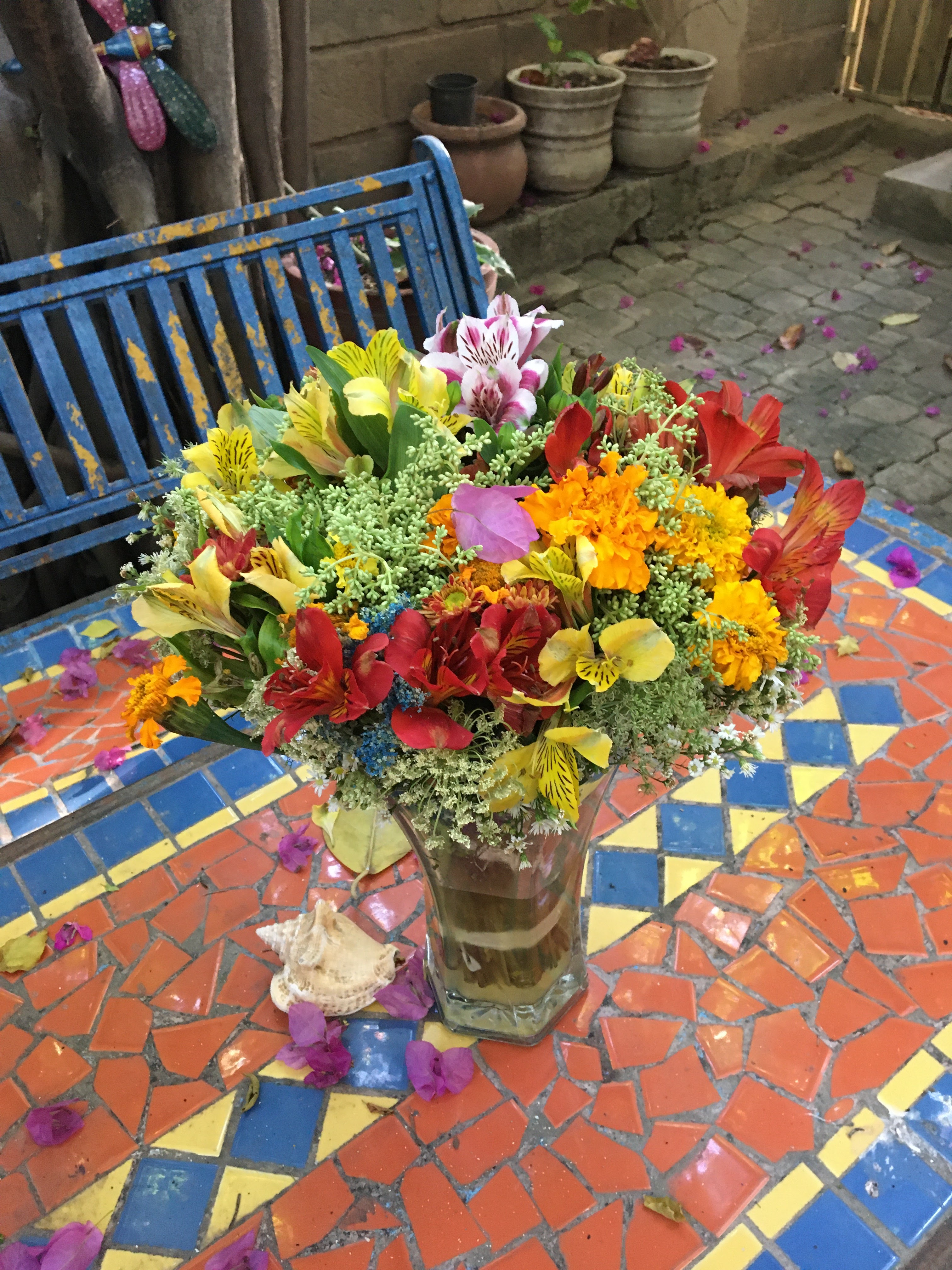
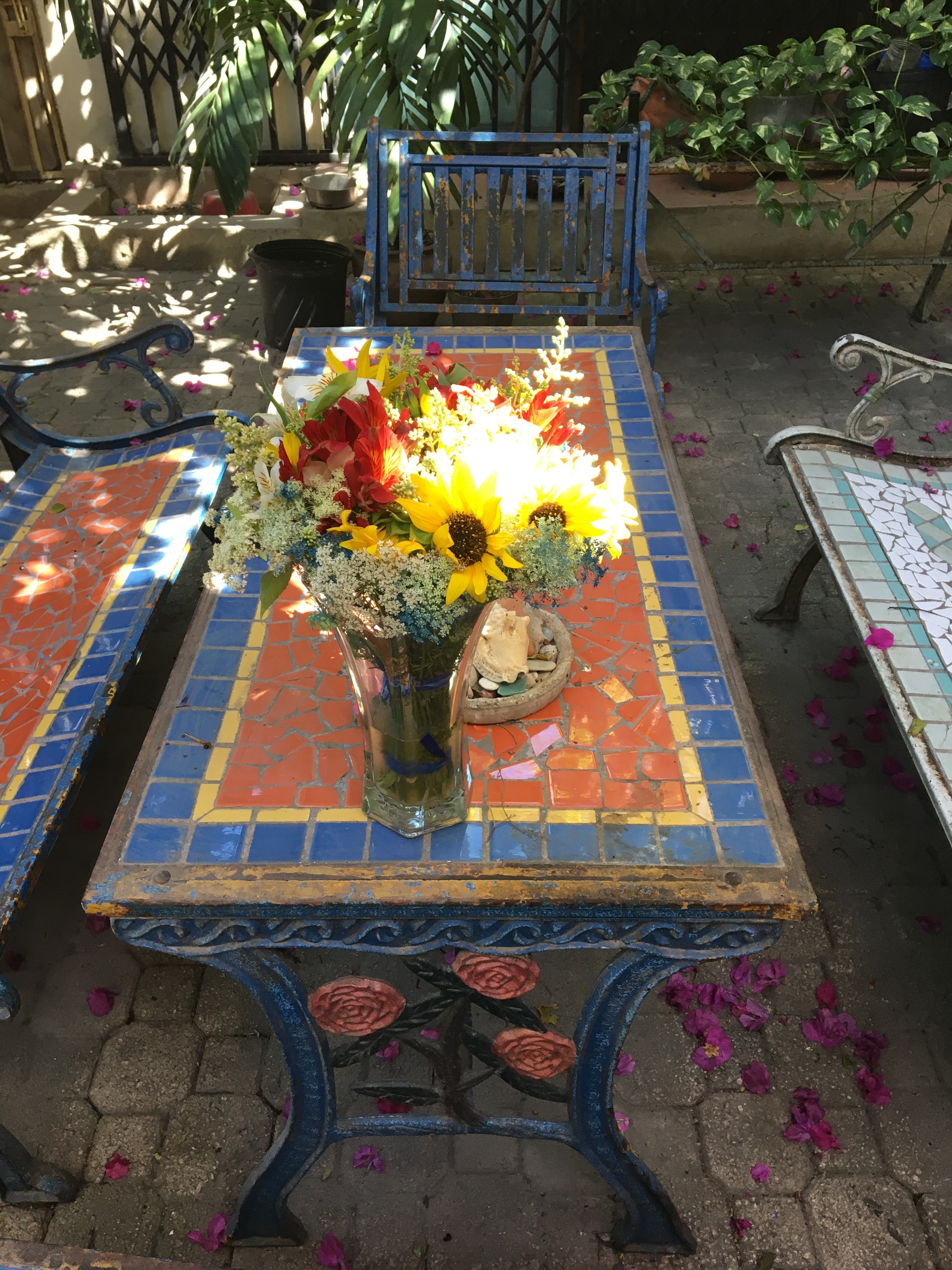
When we left Haiti last December, we had to get rid of many things. Some we sold, some we gave away, some we lost on the way in various fashions. I'm still grieving over a lot of that stuff, even while my grieving is mixed with guilt, since my losses pale to nothing in comparison with the losses of so many in Haiti during these terrible times. One thing I had to leave behind was my outdoor table. The spot where it used to sit looked so bare and forsaken when it was gone. And I remembered so many happy moments at that table. I'm illustrating this post with way too many photos of it. I was never taking a picture of the table itself, but of the meals and flowers and people that it welcomed. We never ate Thanksgiving dinner there, but we ate Christmas dinner there many times, and breakfast, lunch, and/or supper on ordinary days, and I hosted friends for tea on countless occasions. 


Pablo Neruda wrote an Ode to the Table, so I wrote one too. You'll find them both below. 


Ode to the Table

Pablo Neruda


I work out my odes

on a four-legged table,

laying before me bread and wine

and roast meat

(that black boat

of our dreams). 

Sometimes I set out scissors, cups and nails,

hammers and carnations.


Tables are trustworthy:

titanic quadrupeds, 

they sustain

our hopes and our daily life.


The rich man's table,

scrolled and shining

is

a fabulous ship

bearing bunches of fruit.

Gluttony's table is a wonder,

piled high with Gothic lobsters,

and there is also a lonesome

table in our aunt's dining room,

in summer. They've closed

the curtains,

and a single ray of summer light

strikes like a sword

upon this table sitting in the dark 

and greets the plum's transparent peace.

And there is a faraway table, a humble table,

where they're weaving

a wreath

for

a dead miner.

That table gives off the chilling odor

of a man's wasted pain.

There's a table

in a shadowy room nearby

that love sets ablaze with its flames.

A woman's glove was left behind there,

trembling like a husk on fire.


The world 

is a table

engulfed in honey and smoke,

smothered by apples and blood.

The table is already set,

and we know the truth

as soon as we are called:

whether we're called to war or to dinner

we will have to choose sides,

have to know

how we'll dress

to sit

at the long table,

whether we'll wear the pants of hate

or the shirt of love, freshly laundered.

It's time to decide,

they're calling:

boys and girls,

let's eat!


(Sadly, I haven't been able to find out the translator's name. If someone knows, please tell me so I can post it. I don't have my Neruda books with me here, so I'm relying on online sources.)


Ode to My Table

Tables are trustworthy: titanic quadrupeds, they sustain our hopes and our daily life. - Neruda


Trustworthy table,
you sustained us.

You stood on your titanic legs
in our Haitian courtyard
and sustained our daily life.

You held up
my teapot
and my piles of quizzes
and sometimes my feet.

You supported
vases of flowers
and Christmas dinner
and weekend breakfasts.

You witnessed
prayers
and tears
and laughter.

You kept silent about
griefs
and frustrations
and confided joys.

Again and again
we wiped you clean
only to spill more.

Around you
our children grew.

Around you
we argued
and reconciled
and discussed
and were silent.

We talked of
politics
and disease,
love and hate,
friends and enemies.

We talked of
homework
and haircuts,
jokes and dreams.

We sat around you
when we were afraid to sit inside
because an earthquake had leveled so many houses
in our city.

We sat around you
with visitors,
carefully distanced
when we feared germs.

Under you
puppies tumbled
and babies crawled
and ants devoured crumbs.

Above you
birds flew by,
some observed through binoculars,
others not even noticed.

You saw
countless bowls of noodles and rice
croissants and patés and soupe joumou
scrambled eggs and cookies
and thousands of cups of tea.

You saw family,
you saw friends,
some as trustworthy as you.

The day the truck came to pick you up
to take you to your new owner
I cried.

How can I ever replace you?
No table in our new home
will ever be you,

Trustworthy table.


©Ruth Bowen Hersey


Read on for everyone's links!


Check out Michelle Kogan's recipe poem, "Thanksgiving Recipe with a Twist." What do we do when unexpected challenges interrupt Thanksgiving?


Linda's got a recipe too today;  hers is for a perfect Poetry Friday roundup! I especially liked the intriguing suggestion: "You can go rogue." 


It's Friday morning here in Uganda, and some posts came in during the night! I'm going to work soon, but I'll keep checking all day and adding links as I'm able. Be patient; they'll all be up eventually!


Kat, who wrote a snail book herself called What Snail Knows, is in with a review of Irene Latham's new snail book, Snail's Ark. Thanks for the lovely snail mail, Kat and Irene! And Kat even finishes up with a bonus jellyfish!


Laura's written a recipe poem, too, a recipe for a song! A bird poem is totally the way to my heart, and this one's a beaut. 


Alan shares a fascinating post about long poems, and then a rant poem about our times. He gives an alternative name to the genre that I really like: a "What Cheeses Me Off Poem."


Mary Lee has a recipe poem too; hers is for a soap box derby. What a wonderful collection of ingredients!


Marcie's in with a book recommendation (sounds really good!) and a haiku.


Sara's recipe poem details a way to make dinner even when all your ways don't work.


Margaret remembers her mom's cornbread dressing -- and knows that it was really love. She's used the haibun form, which I enjoy so much!


When Jone hosted Poetry Friday a few weeks ago, I couldn't get to her post, and the same thing is happening to me this week. I will keep trying, but meanwhile, go check out her link, since whatever my issue in Uganda is, it will most probably not affect you!


It's nighttime here now, and we just had a power cut. Now that the power is back on, I'm catching up on the last few links to come in. Sorry to keep you waiting!


Heidi has written a "Catalog of Unabashed Change" all about how we do and ought to and must live now. Great stuff, Heidi!


Tanita's recipe poem is about a winter concert. Such a treat, and such a job to prepare!


Kelly's recipe poem is about magic. My favorite line after the end of the power cut is: "Light a candle. Right a wrong."


And Shari has combined an epistolary poem with a recipe poem to make a delicious coffee cake!


I'm going to bed now, friends, and I'll be back in a few hours to post anything that comes in overnight. Thank you for all the yumminess so far!


It's morning in Uganda, and my husband is baking bread for our Thanksgiving gathering this afternoon. We worked Thursday and Friday, so we waited until today for festivities. Our oven only goes up to 350 degrees, so he's using a neighbor's. This morning he went through the yearly ritual of hunting down his mother's recipe. I'm going to try to get next week's lesson planning finished while he bakes. But first, here are the links from the night!


Patricia posted an evocative poem about the "tiny things" that are bringing her gratitude this year.


Tricia got some terrible news, and she posted a recipe for healing. Wishing you comfort and hope and yes, healing, Tricia.


Tiel Aisha Ansari doesn't participate in Poetry Friday, but I love her work and I like to link to it when I'm hosting. Here's her beautiful poem, "Black Ink, Blue Breath."


Here's Irene's Q poem for this week! "How easily we break." Indeed.


Any more links? It's not Friday any more, but don't let that stop you. Thank you, everyone, for participating, and helping make my first Thanksgiving in Uganda a poetic occasion. I am grateful for you, Poetry Friday friends! 


It's Sunday morning, and overnight I got one more link, this one from Carol. It's another recipe poem; this one is a recipe for "a mindful work-in." I'm sure we could all use some relaxation after this busy weekend! 


And Liz has extended the festivities to Poetry Monday, with her lovely and hopeful recipe poem "The Making of a Habitat."

Thursday, November 23, 2023

Poetry Friday Roundup is Here, and Taxonomy!

Welcome, welcome! I'm so happy to have you here in my little corner of the Web. This post goes live on Thanksgiving Day, and so I'm asking you, if you're willing, to include something in addition to your poem, or in your poem, to be thankful for, some reason that your life contains joy in spite of all the horror that goes on in this world. Leave your link in the comments and I'll round up the old-fashioned way. Remember that I'm eight hours ahead of Eastern Time, so I may be sleeping sometimes when you're awake, plus Friday is a workday for me. I'll get everything up there as fast as I can! I have comment moderation enabled, so you won't see your comment immediately. 


For me, the birds have been helping me a lot in the past few years. I got seriously into birding in 2019, when we in Haiti were in a political lockdown for weeks and weeks (we were in person at school only 14 weeks that school year). I decided to learn the birds in my yard, and then as time went on, I became increasingly obsessed. Now that I live in Uganda, I am blessed to be in one of the world's best places for birding. Unfortunately it's not (or at least my house isn't) one of the best places for attending webinars, as I tried to recently to learn about the 2023 eBird/Clements taxonomy update. I'll have to watch the recording instead, as I got kicked off the webinar again and again until finally I gave up 45 minutes in. But even in the few glimpses I had of the speakers and what they had to say, I decided that taxonomy is something I'm thankful for this year. It just makes me feel better about the planet that there are human beings who care so much about getting these tiny distinctions right, about expanding our knowledge of the birds. This year, according to eBird, the "update includes 3 newly described species, 124 species gained because of splits, and 16 species lost through lumps, resulting in a net gain of 111 species and a new total of 11,017 species worldwide!" (You can read more about it at their post here.)


So I decided to write an ode to this wonderful science, taxonomy.


Ode to Taxonomy

Taxonomy,
you clean the closet,
sort the junk drawer,
alphabetize the shelves:
a place for everything
and everything in its place.

Taxonomy,
you pay attention,
study the DNA,
tend to the lumping and the splitting,
notice the tiniest details.

Taxonomy,
you’re a dragon
clawing contentedly through its horde,
seeing what’s there
and feeling richer.

But
Taxonomy,
you’re also poetry:
putting words to the silvery flashes
of feather and beak,
giving language to the overwhelming masses
of teeming life,
naming what is.

The world is ours to love,
ours to see and appreciate,
ours to let be,
ours to learn
and know by name.

Taxonomy,
you see to all that. 


 ©Ruth Bowen Hersey


The first poem is in already, from Linda, who has a collection of gems, as always! Thank you, Linda, and Happy Thanksgiving! Like you, I'm thankful for this community! 


Bridget is in from Switzerland with "a silly take on local real estate." She and all those other critters are thankful for a place to live!


Janice is reading and writing about ravens! I have to get that book!


The Poetry Sisters are writing like Valerie Worth today! Hooray! I love Valerie Worth's writing and am looking forward to all her worthy imitators. The first one to show up is Michelle, who has two lovely entries.


Heidi is marking Thankstaking (go read the explanation) and Climate Friday. Here we all are, knowing...


I was really hoping I'd be able to access Jone's post this time, but nope, still can't. Although I can't read it, I hope you can. You can find it here.


Laura's done a Valerie Worth poem too, and hers is about a hawk! You know I love that!


Linda B.'s also doing Valerie Worth, and encouraging us to get outside! I would love to, but I'm in a class with my ninth graders taking a test (don't worry, I can see them well from my desk), so I can't right now. Later, though...


Alan was inspired by an ordinary event to write a great little poem! 


I'm pausing during a lull (as there are no new comments in my inbox) to reread the roundup so far and realize it contains entirely too many exclamation marks. All the poetry makes me giddy. I can't blame it on Thanksgiving dinner because we aren't eating that until tomorrow. I will try to be less flighty, but I can't guarantee anything.


Mary Lee has a poem in the style of Valerie Worth, too, and hers is about something so small but with so much potential: a ladybug larva. And she's thankful for creativity in all its forms.


Sara is looking at small things with the Poetry Sisters, and she's written about lentils and a doorstop. I'm loving these Valerie Worth poems!


Liz is sharing some Valerie Worth poems too. My favorite lines: "A dog-eared page/creased like a collar,/like a paper crane..." 


Tricia's attic poem is so evocative that I feel like I'm there. And the photo of her son's writer's notebook is priceless, too.


Margaret's eagle poem shows how connected we can feel to natural things, especially birds! Her photo is lovely, too.


Tanita has written some wonderful Valerie Worth style poems, specifically choosing small things likely to be overlooked. "May we," writes Tanita, "by being open, inventive, expressive, and questioning, live our uncertainty and questions into answers that change everything."


Patricia visited but left a link to my blog instead of hers. Patricia, come back and link me!


Irene is imagining "If the Sun Had Shoes." And she's been having a wonderful time walking around in her own shoes!


Carol is writing Valerie Worth poems too, and hers are all about Thanksgiving. Sounds delicious and beautiful! 


Denise is imagining "the last love letter" she'll write, and she has some questions that I also would like to ask. Thanks, Denise!


Patricia is sharing three beautiful poems that are responses to how things are right now.


Thanks, everyone, for participating! I hope you all had a wonderful Poetry Friday!


Friday, January 28, 2011

Poetry Friday: Ode to the Lizard

I finished reading The Dreamer this week. It's a fictionalized biography of Pablo Neruda, and at the end there are some of Neruda's poems. I loved the book (here's my review) and I love this poem:


Ode to the Lizard
Pablo Neruda (translated by Margaret Peden)

On the sand
a
lizard
with a sandy tail.
Beneath
a leaf,
a leaflike
head.

From what planet,
from what
cold green ember
did you fall?
From the moon?
From frozen space?
Or from
the emerald
did your color
climb the vine?

On a rotting
tree trunk
you are
a living
shoot,
arrow
of its foliage.
On a stone
you are a stone
with two small, ancient
eyes -
eyes of the stone.
By the
water
you are
silent, slippery
slime.
To
a fly
you are the dart
of an annihilating dragon.

Here's today's Poetry Friday roundup.

Friday, August 30, 2019

Poetry Friday: Ode to Kool-Aid

I love this poem by Marcus Jackson because it brings back my childhood in a powerful way. I remember mixing up the Tupperware pitcher of Kool-Aid in various kitchens in various houses where we lived. The little cloud of color at the bottom of the plastic cylinder (and how different was my view of plastic back then, before the stuff was choking our planet), my "healthy" version of the recipe where I added only 3/4 cup of sugar instead of a full cup (see the word "unsweetened" on the package), the brightly-colored mustaches on myself and my brothers after our tumblers of Kool-Aid, consumed with a cookie or two.

Ode to Kool-Aid
Marcus Jackson

You turn the kitchen
tap's metallic stream
into tropical drink,
extra sugar whirlpooling
to the pitcher-bottom
like gypsum sand.
Purplesaurus Rex, Roarin'
Rock-A-Dile Red, Ice Blue
Island Twist, Sharkleberry Fin;
...
We need factory-crafted packets
unpronounceable ingredients,
a logo cute enough to hug,
a drink unnaturally sweet...

Here's the rest.

Kathryn Apel has the roundup this week.