Thursday, October 13, 2022

Poetry Friday: Birdtober Day Fourteen: Philippine Eagle

Photo Source: eBird.com


Today's prompt bird, the Philippine Eagle, is one of the most endangered and rarest birds of prey. It has some other names, too, like the King of Birds and the Monkey-eating Eagle. But the thing I enjoyed most when learning about this bird was watching the Philippine Eagles' parenting (see the video below for amazing National Geographic footage). This species produces one egg every two years and both parents are intensely involved in the care and feeding of the chick. They provide a constant stream of snacks like bats, pigs, lemurs, and other delicacies. The baby starts leaving the nest at about five months, but childhood isn't over yet, as the parents keep a close watch, and continue feeding duties, for eighteen more months. The adolescent practices flying, bouncing up and down impressively before taking off. Many parallels with human parenting came to mind, but perhaps the one that made me smile most was the chick tossing back his head so that his crest, a slightly smaller version of the one on his parents' heads, falls into a perfectly coiffed mane. It reminded me of my son saying, at around nine, "It's taken me years to get my hair this way." And of course, when I write in my poem (below) about the full nest, the empty nest is never far from my thoughts.


Eagle Junior fills the nest,

eating snacks he likes the best

served up by his dad and mom:

lemurs, lizards, it's the bomb.

He's the center of their lives,

and they make sure he survives

while he practices his flight

all day long, and sleeps at night,

while he tends his growing mane

and works his muscles and his brain.

Eagle Junior's loved the best

And his presence fills the nest. 


©Ruth Bowen Hersey


Here are some more sites I used for background reading: Edge of Existence, Philippine Eagle Foundation, and Rappler.com.


More birds I wrote about this week: Conure (Carolina Parakeet), Razorbill, Pileated Woodpecker, Saffron Finch, Black Drongo, and Turtle-Dove. And there are links to last week's birds in this post.


Matt Forrest Essenwine has this week's roundup.


Wednesday, October 12, 2022

Birdtober Day Thirteen: Turtle-Dove

When you search "Turtle-Dove" on eBird, seven species come up. There's the Mauritius, Rodrigues, European, Dusky, Adamawa, Oriental, and Malagasy. The first two are extinct, but most of the others are very widespread. And the Mourning Dove is colloquially called a Turtle-Dove, too.


European Turtle-Dove; Photo Source: eBird.com


Turtle-Doves symbolize love. In Song of Solomon, when it says "the voice of the turtle is heard in the land," it's referring to a Turtle-Dove, not a turtle. They are often in pairs, like in "The Twelve Days of Christmas." And surely part of the connection is that "love" and "dove" rhyme, see also lovey-dovey.


On the second day of Christmas, love

Gifts sweethearts with a Turtle-Dove.

A pair of birds is even better,

More loving and cozy than a sweater.

But birds are best when they are free,

So to show love, just let them be.


©Ruth Bowen Hersey


Tuesday, October 11, 2022

Birdtober Day Twelve: Black Drongo


The description of this YouTube video says that the sound of the Black Drongo is "one of the most common sounds of birding in India." I haven't been to India, though it would be wonderful to bird there some day. In the meantime, I love the way birds become part of the soundtrack of our lives. Where I live, it's the constant racket of the omnipresent Hadada Ibis. And in the South Indian state of Goa where this video was made, it's the Black Drongo. With some of the words eBird uses to describe the calls of the Black Drongo, I wrote a haiku for today.


Chatter, flute, whistle

Singing pair of Black Drongos

Soundtrack of morning 


©Ruth Bowen Hersey


Monday, October 10, 2022

Birdtober Day Eleven: Saffron Finch


Photo Source: eBird.com


Yesterday I remarked that the bird of the day, the Pileated Woodpecker, appeared in four of my checklists. The Saffron Finch, a South American bird, appears in 49. In the months I spent in Paraguay, I saw these birds many times. In fact, they are extremely common, in spite of their exotic, spicy name. In one Saturday morning birding outing in April with my brother, we saw 29 individuals. 


It takes 75,000 saffron crocus flowers
to make a kilo of saffron.
Saffron costs more than gold.
Put a tiny pinch in your paella.


It takes only one Saffron Finch
chirping in a tree
to warm up your day
for free.


©Ruth Bowen Hersey


Sunday, October 09, 2022

Birdtober Day Ten: Pileated Woodpecker


I have Pileated Woodpeckers on four of my checklists, all in 2021. Two of those checklists were in Missouri, one in Kentucky, and one in Tennessee. The main impression I had of these birds when I saw them was, "Wow! They are so big!" Pileated Woodpeckers are 16 to 20 inches long. 


For this bird today, I'm not writing a new poem, but instead sharing one I wrote for a friend back in November 2020 when she sent me a photo of a Pileated Woodpecker while I was still living in Haiti.


An Exchange of Woodpeckers


You sent me your woodpecker
And I sent you mine.


Yours:
Pileated,
Dryocopus pileatus,
Crest a bright cherry red,
Enormous, powerful bill.
Black and white striped head,
Large, glossy, black and white body,
Long black tail,
Hanging out in a maple tree with a few yellow leaves still clinging
As November began.


Mine:
Hispaniolan,
Melanerpes striatus,
Grey-headed,
With a red crown as bright as the northern guy’s,
Enormous, powerful bill,
Yellow and black striped back,
Long black tail,
Peering down from a bright green neem tree
As November began.


An exchange of woodpeckers
Across the miles,
Photos flying faster than these birds ever could,
Showing their faces to people in another place
Before the woodpecker cousins finish eating their latest bugs. 


©Ruth Bowen Hersey


Birdtober Day Nine: Razorbill


Photo Source: eBird.com


I watched a video of a Razorbill who went off course ten years ago and ended up in Florida. Before 2012, there were only 14 recorded sightings of Razorbills in Florida. That winter, there were flocks of more than a hundred seen.


Northern bird in southern clime:

Tropical vacation time! 

Razor sharp bill catching fish,

Batlike wings that flap and swish.

Swimmer sleek in black and white,

Enjoying holiday delight! 


©Ruth Bowen Hersey


Saturday, October 08, 2022

Birdtober Day Eight: Conure

Photo Source: eBird.com


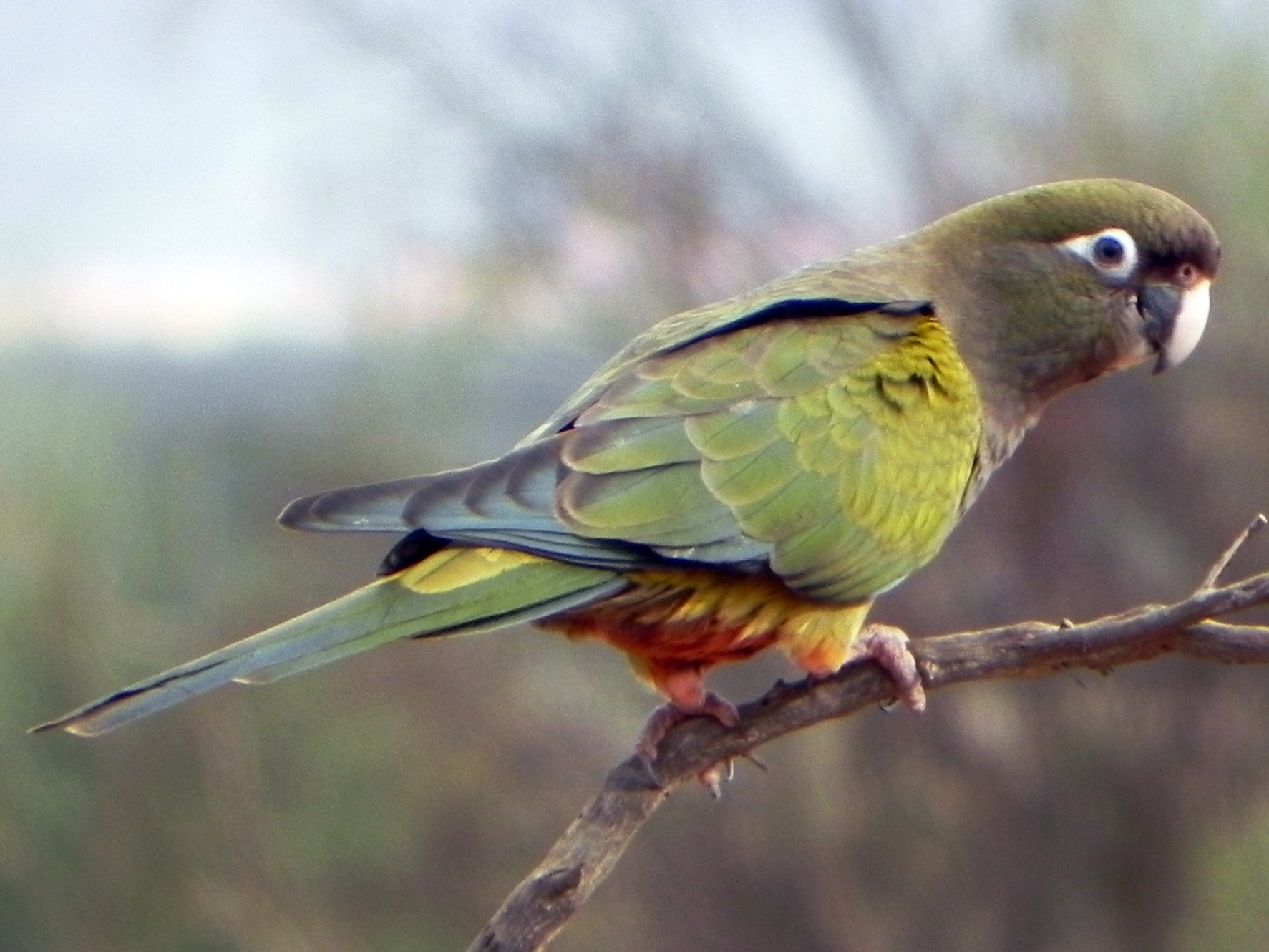
If you look up "Conure" on eBird, you won't find anything, because the word refers to a class of birds rather than a specific species. A conure is a small to medium sized parrot or a large parakeet in the Americas. The Burrowing Parakeet, pictured above, is an example. It's sometimes called a Patagonian conure.


I decided to write about an extinct conure, the Carolina Parakeet. Since I had read that these birds were extinct, I was surprised to see that there were three listings on eBird with photos. When I clicked on them, I saw that they were all photos of pages from books, descriptions of Carolina Parakeets, in the context of Alexis de Toqueville reminiscing about gleefully killing them in 1831. De Toqueville's friend Gustave de Beaumont commented how bored they would have been during their time in Tennessee if they hadn't had the chance to kill birds. Now these "red and yellow parrots unequalled in their beauty," in de Beaumont's phrase, are nothing but words on a page. The last Carolina Parakeet died in captivity in the Cincinnati Zoo in 1918.


Imagine
the red and yellow parrots
unequalled in their beauty
flying around the woods
of Memphis, Tennessee.


Imagine
the red and yellow
unequalled in their beauty
flying around the woods
of Memphis, Tennessee.


Imagine
     red and yellow
                             beauty
flying around
     Memphis, Tennessee.


Imagine

                               beauty
flying


Imagine. 


©Ruth Bowen Hersey


Thursday, October 06, 2022

Poetry Friday: Birdtober Day Seven: Secretarybird


Photo Source: eBird.com


Surprise! I managed to write a Birdtober poem every day this week. I'll add links to them later in this post. 


Today's prompt is a Secretarybird. These amazing birds, over four feet tall and found on the coat of arms of South Africa and the emblem of Sudan, are endangered now, due to habitat loss. To the people who live near them, they represent intelligence and protection. (You can read more about them in my poem and this Wikipedia article is an interesting place to go next.) The Terror Birds mentioned in the poem are already extinct, and I hope the Secretarybirds won't be next.


Stomping
Striking
Killing snakes
a Secretarybird

Hunter
Doing
What it takes
that Secretarybird

Terror bird
Would hunt
the same
as Secretarybird

Quill-like
Feathers;
Hence its name:
the Secretarybird

Roosting
In A-
cacia trees
two Secretarybirds

Croaking
with their
families:
Secretarybirds


©Ruth Bowen Hersey


Here are the poems from the rest of the week:


Saturday: Rooster 

Sunday: Campo Flicker 

Monday: Macaroni Penguin

Tuesday: Hummingbirds 

Wednesday: Swan 

Thursday: Zebra Finch 


Here's this week's roundup. 


Wednesday, October 05, 2022

Birdtober Day Six: Zebra Finch


Photo Source: https://kidadl.com/facts/animals/zebra-finch-facts


I chose the Zebra Finch photo here to illustrate this Australian bird because I wanted to make it clear where the name came from. In this photo you can see its stripy tail. Yes, its tail is black and white, but it strikes me as an odd way to name this very distinctively marked bird. What about its brown cheeks, its spotted sides, its orange bill, the grey area below its chin? All of these things are highlighted in the description on eBird, but none of them influenced its name. 


In this picture you can't see another distinctive mark that eBird mentions: its black and white "mustache." In the picture below, you can see it better.


Source: https://favpng.com/png_view/bird-bird-zebra-finch-drawing-painting-png/b7RVq4Yr


In the past I've often speculated about why certain birds are named after one trait instead of another. I decided to write my Zebra Finch poem about this idea.


Yes, for sure I am a finch,
But why focus on one inch?
Why not talk about the rest,
For I am dapper, and well-dressed.
You could bring up my lovely bill
Bright orange, pecking, rarely still.
Or my vest with polka dots
Or my grey bib, which I like lots.
I have a mustache, very chic,
And did I mention my fine beak?
I’m just saying that I fail
To see why you discuss my tail
Instead of all my other features
When naming me among the creatures.
Yes, for sure I am a finch,
But why focus on one inch?


©Ruth Bowen Hersey


Tuesday, October 04, 2022

Birdtober Day Five: Swan


Photo Source: eBird


Twenty-six years ago, my husband and I spent Christmas in northern Japan, and we were taken to see swans that had migrated from Siberia. I remember we joked about how unbelievable it was that this frigid place was warmer and more pleasant than the home they had left in Siberia. I don't know now if they were Tundra Swans or Whooper Swans; both of these winter in Japan and spend the rest of the year in Siberia. This happened long before I was interested in birds and eager to identify them correctly. But I was overwhelmed by the beauty of the swans.


Northern visitors

Breathe out clouds of warm whiteness

Feathery snowdrift


©Ruth Bowen Hersey


Monday, October 03, 2022

Birdtober Day Four: Hummingbirds


There are over 350 species of hummingbirds in the world. We don't have them where I live, though we have sunbirds, which are reminiscent of hummingbirds because they too are small and iridescent. 


Last year during Birdtober I wrote about the Vervain Hummingbird, an island endemic, here, for an Artist's Choice day. This time I decided to write about hummingbirds in general.


Most are between three and four inches long
But they can fly 500 miles non-stop, alone.

Most weigh less than half an ounce
But they can visit 1000 flowers in one day.

A nest the size of a golf ball, eggs the size of jelly beans,
But they eat twice their body weight in 24 hours.

Heartbeat of 1200 beats per minute while flying
Slows down to almost nothing while sleeping.
To rest up for another day of being
Tiny
But
Mighty.
 

©Ruth Bowen Hersey 


Here's another source of hummingbird facts. 


Sunday, October 02, 2022

Birdtober Day Three: Macaroni Penguin


Photo Source: eBird.com


Why are these guys called Macaroni Penguins? Here’s eBird’s explanation: “Disappointingly, named for the resemblance of its spiffy, 'fashionable' crest to the hairstyle of fashionable youth, or 'macaronis', and not for the pasta-sauce-orange color of the crest itself.”


You can watch the video to get some of the references in the poem explained.


Spiffy, tony,
Macaroni
Faithful spouse
In matrimony,
Makes a scrape
With ceremony,
Throws out one egg
(It’s a phony).
Listen to my testimony:
You’re the greatest,
Macaroni.


©Ruth Bowen Hersey


Reading Update

Book #44 of the year was Liturgy of the Ordinary: Sacred Practices in Everyday Life, by Tish Harrison Warren. I really enjoyed this book, which encourages us to find the connections with God in ordinary moments, like waking up, brushing our teeth, losing our keys. The writing is lovely.


Book #45 was a reread (a rererereread), Sense and Sensibility, by Jane Austen. In times of stress, I always return to these old favorites.


Book #46 was another reread, though this one was only for the second time. It was Beginners: The Joy and Transformative Power of Lifelong Learning, by Tom Vanderbilt. (The link is to my review the first time I read it.)


Book #47 was Paris to the Moon, by Adam Gopnik. I enjoyed this story of how the Gopniks moved to Paris so much that book #54 was another Gopnik title, Through the Children's Gate: A Home in New York.


Book #48 was Graceland at Last: Notes on Hope and Heartache from the American South, by Margaret Renkl. This is a collection of op-ed pieces that appeared in the New York Times. Renkl lives in Nashville and writes about politics and the environment. I enjoyed this book.


Book #49 was The Assignment, by Liza Wiemer. This YA title is about what happens when a high school class is given an assignment in history that some of them, and two in particular, find offensive. They're asked to argue in favor of the Nazis' Final Solution. 


Book #50 was My Lover's Lover, by Maggie O'Farrell. Though not my favorite O'Farrell title yet, this one was intriguing. I'm eagerly awaiting her new book, The Marriage Portrait, which I have on hold at the library.


Book #51 was The God of Small Things, by Arundhati Roy. I can't believe I hadn't read this book yet, especially considering how much I love many Indian novels. Now I'm about to embark on her newest book.


Book #52 was 96 Miles, by J L Esplin. I wish I were still teaching middle school English and could share this with my students. This was so good, suspenseful, and exciting! Now I want a sequel!


Book #53 was The Guide, by Peter Heller. I've been waiting to read this one for a long time. While it wasn't as good as the The River, to which it's a sequel (the link is to my review of that one), this one was entertaining. I do like Peter Heller's writing.


Book #55 was Ghosted, by Rosie Walsh. Like the other book of Walsh's I've read, The Love of My Life (the link will take you to my review of that one), this one was very twisty. I was glad I didn't stop reading what seemed at first to be a pretty straightforward story. All my assumptions were shown to be wrong in quite unexpected ways.


Book #56 was a YA title called Moonrise, by Sarah Crossan. It's a verse novel set in Texas, and it has themes like the death penalty, family dysfunction, and sibling relationships. It was very readable and well done, but I wish an American editor had worked on it because I just didn't buy that the characters were Americans because of all the British usages in the writing. 


Book #57 was a novel in French that I'm going to be teaching, Petit Pays, by Gaël Faye. I thought it was brilliantly written and gripping. It's a story of a French-Rwandan boy living in Burundi in 1994. Highly recommended. I'm looking forward to teaching it.


Book #58 was The Kurdish Bike, by Alesa Lightbourne. I enjoyed this book, recommended by a friend who has also taught at international schools, like me and like the protagonist of this novel. My only complaint is the head-spinning dénouement, in which huge numbers of issues are resolved in a few pages. I need to go back and read the ending again to get it all straight in my mind. I liked the portrayal of life in Iraq among the Kurds.

Saturday, October 01, 2022

Birdtober Day Two: Campo Flicker


Photo Source: eBird.com


When we lived in Paraguay, I often saw three Campo Flickers all together. Rarely did I see one or two of them; if one of them was there, all three were. I wondered what their relationship was. Were they a pair with their offspring? (They all seemed the same size.) Were they a little group of buddies? I don’t know.


These birds used to be called Field Flickers. A student at our school had found them in her bird book, and she was excited to show them to me on our campus. “Look at the Field Flickers!” she said, and again, there were three of them. I wondered if they were the same three we saw at our apartment, quite nearby, but of course I didn’t know for sure.


I decided to write a little nursery-rhyme style poem about these Campo Flickers.


Three Campo Flickers,
Early morning crew,
Perched on the power line
Looking down on you.
If one flew away,
Then there’d be two.

Two Campo Flickers
Wouldn’t have much fun,
Making sounds like hungry puppies
In the noonday sun.
If one flew away,
Then there’d be one.

One Campo Flicker
Lonesome in a tree
Late in the afternoon
Eating bugs — you see?
No, no, of course you don’t,
Cause look! There are three!

Three Campo Flickers
Taking to the sky.
Three woodpeckers fly away,
Yellow flashing by,
Almost always three of them,
Though I don’t know why.


©Ruth Bowen Hersey


Friday, September 30, 2022

Birdtober Day One: Rooster

Photo Source: https://www.raising-happy-chickens.com/why-have-rooster.html

I love that the first prompt of Birdtober this year is Rooster. Because let’s face it, no matter how we long for the new and exciting lifers, no matter how much we travel to exotic locations in search of rarities, the bird we see and hear most often is a chicken. When I make recordings of the birds in my neighborhood, there’s nearly always a rooster in the background. The same was true in Haiti, where the rooster — at all hours of the day and night — was the most iconic sound of all. For many years we lived near a cockfighting ring, and there was many a fighting rooster raised in our neighborhood. A beloved late friend whose job took him around the world used to say that one loud rooster followed him everywhere he went. 


And if you look at a rooster closely, you’ll see that it’s as beautiful as any other bird we seek. It’s just the commonness of it that blinds us to how amazing it is.


Sometimes people complain about the sound roosters make. Can you believe that? There have been several stories in the news in France about this over the past few years. I couldn’t find an outcome for the latest case, that of Pitikok. Holiday-makers eager to enjoy peace and quiet in a rural retreat took Pitikok’s owner to court because Pitikok was too noisy. The owner invoked the new law protecting the “sensory heritage” of the countryside from noise complaints. The most recent articles I could find said that Pitikok’s owner wanted to withdraw from the case because he had been receiving threats.


Can’t we all, birds and people, just get along?


Here’s my haiku about Pitikok and his noisy brethren. 


This daily alarm
Sound of countryside mornings
Will not be silenced


©Ruth Bowen Hersey


Thursday, September 29, 2022

Poetry Friday: Here Comes Birdtober!

Hello, Poetry Friday friends! It has been a while since I've managed to post anything for Poetry Friday. The last time was in July, and I just counted and discovered I've only posted twenty Poetry Friday posts in all of 2022. 


When I chose "Beginner" as my OLW for the year, little did I know I'd be drowning in beginnings again in the second half of 2022. My husband and I moved to another new country in August, and we're now living and working in the beautiful city of Kampala, Uganda. If you're thinking there must be a story there, you'd be right, and maybe some day I can tell it to you over a cup of tea. In the meantime, here I am, learning all the things, a Beginner again.


Counterintuitively, I have often found that an answer to being overwhelmed is to add something creative to the mix. So I'm going to try that, and see if it works this time. October will be starting on Saturday, and I think I'm going to attempt Birdtober again. It was one of the most fun things I did last year, and October 2021 was wilder than this year's is likely to get (I hope). Below you'll see the list of prompts I'm planning to use - there are several floating around, but this is from the same person whose list I used last year (you can see her site here), and I really like it. Birdtober is an offshoot from Inktober, and it's supposed to be for visual artists, but I wrote poems last year, and that's my intention this year also.


As always when I embark on one of these projects, I'm not committing to every day, but I hope to post quite a few of the days in October. And in the meantime, here's a link to all my Birdtober poems from 2021.


Tabatha has the roundup this week!

Saturday, August 06, 2022

Reading Update

Book #37 of the year was The Memory Thief, by Emily Colin. I kept reading this book, about a man who dies in an avalanche but then is somehow still present, because I wanted to figure out what exactly the premise was. I guess the premise sort of made sense in a paranormal way, but it wasn't really my kind of book.


Book #38 was Jonathan Martin's new book, The Road Away From God: How Love Finds Us Even As We Walk Away. I am a Martin fan; I've read his shipwreck book at least five times. (You can see what I wrote about it the first time in this post.) This book is geared more for people who are thinking about walking away from their faith, for whatever reason. He takes as his metaphor here the story from the gospel of Luke when two disciples are walking away from Jerusalem after the crucifixion of Jesus. They meet a stranger on the road, who turns out to be the risen Lord. Even though they were walking away, Jesus still meets them. This book includes much more politics than the previous one, giving specific examples of why people have chosen to walk away from Christianity, particularly the evangelical flavor. Martin certainly knows his way around a metaphor, and this book is worth reading. Here's a taste:


"Life isn't plotted so all the movements are linear, telegraphed, obviously related. It's much more chaotic, clumsy, and ambiguous than that. We rarely know what's happening at the time, or really what we are doing or why, much less what anything actually means. But for most people I know who have been on the road, there has been a particular moment when they realized, with some kind of deep knowing, that there was no going back to the world as it was, the world as they knew it before. This was the moment that sent them out walking." 


Book #39 was Ready Player Two, by Ernest Cline. This is the sequel to Ready Player One, which I read for my Adolescent Lit class back in 2012 and wrote about in this post. This one is more of the same, people living their lives virtually instead of IRL, neglecting the planet. There's more of the scavenger hunt content, based on movies and popular culture from the eighties. Like with the first book, I found myself wondering who Cline's audience is. Although I was a teenager in the eighties, I don't have nearly the encyclopedic knowledge of eighties lore than his characters do. The characters are a little flat, and there's lots and lots of wish-fulfillment in the playing and winning of video games, the endless amounts of money, and the adrenaline-fueled plot. 


Book #40 was Shauna Niequist's I Guess I Haven't Learned That Yet: Discovering New Ways of Living When the Old Ways Stop Working. This is my second time reading it since it came out in April. (The first time, I wrote about it in this post.) This is a really good book. Here's Shauna: "I'm sad that this is a plot point I have to incorporate into the story of my life. That's the heart of it. I don't want this part. I want to stick my fingers in my ears like a child. I want to lock the door against it. You can't be a part of my story."


Book #41 was a reread, Persuasion, by Jane Austen. I don't even know how many times I've read it before. The last time was in 2019 and I wrote about it here. This time my reading was instigated by watching the new adaptation of the novel on Netflix. It has been much discussed on the internet. It was silly and anachronistic and I still can't say I hated watching it. And it made me read the book again, which is always a good thing. Austen is always a comfort read for me. 


Book #42 was Kentucky poet Ada Limón's latest book of poetry, The Hurting Kind. Limón was just named the new Poet Laureate of the United States. I enjoy her work and have shared several of her poems before on this blog. This first reading of her book was rewarding, and I'll be reading it again.


Book #43, The Fight for My Life: Boxing Through Chemo, by Kelly Motley was written by a friend who is married to another friend I met in graduate school. I got to go to an event that Kelly did in Nashville promoting this story of how she fought breast cancer, using boxing and a macrobiotic diet. This is an intense book, and Kelly doesn't shy away from describing the agony she experienced. Sometimes I had to put it aside for a while because it is so intense! She emerges as a strong, indomitable woman facing a formidable foe. Probably the part that will stay with me the most is the epic saga of her hair. Her nutritionist said that her clients never lose their hair during chemo. I won't give away what happens, but just know that my words "epic saga" are appropriate! I liked the writing, the honesty, and the unflinching description.

Thursday, August 04, 2022

Spiritual Journey Thursday: Summer Nurtures our Souls

Carol Varsalona is our host today and has asked us to reflect on the way summer nurtures our souls. I decided to go (mostly) wordless and show you some photos I've taken during cycling and birding expeditions in Kentucky and Tennessee this summer.


In that last one, you can see a foreshadowing of the next season!

Thursday, July 21, 2022

Poetry Friday: Every Mile


This week, my total number of cycling miles since I joined Strava in April clicked over to 1000. (Strava is an app to keep track of athletic activity.) A thousand miles, mostly on a tandem (the one in the picture, from summer days in Kentucky, or the one in Paraguay), but some on a single bike. 


The poem I'm sharing today is really a song, written by one of my favorites, Nichole Nordeman. It's about miles. (Scroll past the video to read the words.) As I listen to this song, I think about the miles from this year so far. Some were fun and exhilarating, coasting or even pedaling all out downhill, going out-of-control fast. Some were painful, endless climbs, in the lowest gear. I even fell off my single bike a couple of times, once landing hard enough that I had to replace my helmet. (Always wear a helmet, kids.) There were a bunch of literal miles, and it's also, of course, a metaphor for all that I can't go into. You have your own miles; you know what I mean.


Every Mile Mattered

by Nichole Nordeman


Spread the map on the table

With the coffee stain

Put your finger on the places

Show me where you've been


Is that California

Where your teardrops dried?

You drew a circle around Georgia.

Can you tell me why?


I see should have beens, could have beens

Written all over your face,

Wrong turns and bridges burned,

Things you want to change


It's history

You can't rewrite it

You're not meant to be

Trapped inside it


Every tear brought you here

Every sorrow gathered

It's history

But every mile mattered


Get the box off the top shelf

With the black and white

Snapshots of your old self

In a better light

Ghosts and regrets back again

I can see it in your eyes

Send them home, let 'em go

Don't you think it's time?


It's history

You can't rewrite it

You're not meant to be

Trapped inside it


Every tear brought you here

Every sorrow gathered

It's history


Every road and every bend

Every bruise and bitter end

All you squandered, all you spent

It mattered, it mattered


Mercy always finds a way

To wrap your blisters up in grace

Every highway you'd erase

It mattered, it mattered

But it's history

It don't define ya

You're free to leave

It all behind ya


Every tear brought you here

Every sorrow gathered

It's history

Every mile mattered

Every mile mattered


I shared this song once before, in 2018, with some thoughts.

Mary Lee has the roundup this week.

Thursday, July 14, 2022

Poetry Friday: July


I'm in the United States during this warm, dry summer. Some of the best moments in the last few weeks have involved friends, family, birds, and bicycles. I took the coneflower photo above on a morning birding expedition a couple of days ago.


Here's a poem about July:


July Day

by Babette Deutsch


The afternoon sways like an elephant, wears

His smooth grey hide, displays his somnolent grace, weighing

The majesty of his ponderous pace against

The slyness twinkling in an innocent eye.


Keep reading here, where the metaphor of the "elephant afternoon" goes on. 


Here's this week's roundup.