Thursday, April 05, 2018

Spiritual Journey First Thursday: Poetry

It's the first Thursday of the month, and that means a collection of posts on spiritual journeys.  You can find today's roundup here.  This month the topic is poetry, which is appropriate since we are in the first week of National Poetry Month.

I remember a lecture in graduate school where the professor said that the Poet (capital P) had taken the role of God in modern life.  I dismissed this as complete nonsense (not aloud, just in my mind), and actually couldn't even imagine what such a statement might mean.  Today, while I still dismiss equating God with a human Poet, capitalized or not, I understand the concept a bit better.  Poetry goes beyond the mundane; it expresses thoughts and emotions that go deeper than a typical conversation on a typical day.  It's clear that for many people there is a connection between poetry and spirituality; perhaps we could say that the poet takes the role of a priest or holy person (not God), ushering our thoughts past the ordinary and into something more ineffable.

This idea of poets (or artists in general) goes along with the idea C.S. Lewis expresses in The Great Divorce.  A visitor from Hell to Heaven (The Ghost) is gaping at the surroundings and wishing to paint them.  He falls into conversation with a resident of Heaven (The Spirit).

"'I should like to paint this.'

'I shouldn't bother about that just at present if I were you.'

'Look here; isn't one going to be allowed to go on painting?'

'Looking comes first.'

'But I've had my look.  I've seen just what I want to do.  ... I wish I'd thought of bringing my things with me!'

The Spirit shook his head, scattering light from his hair as he did so.  'That sort of thing's no good here,' he said.

'What do you mean?' said the Ghost.

'When you painted on earth - at least in your earlier days - it was because you caught glimpses of Heaven in the earthly landscape.  The success of your painting was that it enabled others to see the glimpses too.  But here you are having the thing itself.  It is from here that the messages came.  There is no good telling us about this country, for we see it already.  In fact we see it better than you do.'

'Then there's never going to be any point in painting here?'

'I don't say that.  When you've grown into a Person (it's all right, we all had to do it) there'll be some things which you'll see better than anyone else.  One of the things you'll want to do will be to tell us about them.  But not yet.  At present your business is to see.  Come and see.  He is endless.  Come and be freed.'"

(Look at the copy I found on my shelf!  It was published in 1969 and it is dusty and missing its back cover, and I love it.)

I appreciate Lewis' musings on art here - both that it can be a way to finding God, and that it is much less than God.  That is how I think of poetry and its role in my spiritual journey.  It can fill me with love for Creation, but it can't replace the Creator.  In the Bible, poetry is used as worship, and as expression of emotions positive and negative.  But neither the poetry nor the poet is the point; the point is God's splendor and majesty.

As long as poetry maintains its proper place, it can absolutely be a part of my spiritual practice.  And it is; both reading it and writing it.  Here's a poem I've loved since high school, a poem which helps me think about the beauty of the world.

God's World
by Edna St. Vincent Millay

O world, I cannot hold thee close enough!
Thy winds, thy wide grey skies!
Thy mists that roll and rise!
Thy woods, this autumn day, that ache and sag
And all but cry with colour!  That gaunt crag
To crush!  To lift the lean of that black bluff!
World, world, I cannot get thee close enough!

Long have I known a glory in it all,
But never knew I this;
Here such a passion is
As stretcheth me apart.  Lord I do fear
Thou'st made the world too beautiful this year.
My soul is all but out of me, - let fall
No burning leaf; prithee, let no bird call.


I felt that way yesterday as I took this picture.  Obviously my world is very different from the autumn day Millay describes, but just look at that sky!  "Lord, I do fear thou'st made the world too beautiful this year." 


Sunday, April 01, 2018

What I Learned in March

I think I'm not very good at doing these posts, because although I try to keep a list through the month, it never gets much on it.  Still, since I did January and February, I'll try March too.  My March list has only two entries, both names: Annie Dillard and Parker Palmer.

More and more, it feels to me that life is about speed, careening through my life and through history, trying to keep up with the increasingly mystifying news of the world and with the breakneck pace of each school year, changing topics and activities to keep my students engaged, rushing through my work so that I can go to bed and then get up the next morning and do it all again.   Both Annie Dillard and Parker Palmer, though, help me to slow down and to reflect on what it's all about.

In my February post I wrote that I am participating in a discussion group of Palmer's book The Courage to Teach.  This continues to lead to nourishing conversations, the details of which come back to me during my teaching days and during ongoing interactions with friends from the group and sometimes even in dreams.  We've talked about paradox and the nature of knowing, about how our strengths and our weaknesses as teachers are sometimes two sides of the same coin.  Sometimes we envy Palmer the rarefied air of his work at the university level, and compare it ruefully to the flatulence humor of our own workplace, but I've taught college too, so I get that his job isn't all pure learning and shiny enthusiastic students.  I just love the way his thought, put down on paper, facilitates our ability to think in new ways.

Annie Dillard's thought is mind-stretching for me, too.  This month I read an essay of hers that blew my mind in all the best ways, "An Expedition to the Pole."  It can be found in The Abundance and Teaching a Stone to Talk.  Long and discursive, the essay is hard to quote because it is the opposite of sound-bytes.  Annie Dillard's writing is the anti-Twitter.  In this essay she is comparing attending church and participating in its ancient rituals with being a polar explorer.  In both endeavors, we are aiming for the ineffable but sometimes get bogged down by the day-to-day.

Listen to this:

"A high school stage play is more polished than this service we have been rehearsing since the year one.  In 2,000 years, we have not worked out the kinks.  We positively glorify them.  Week after week we witness the same miracle: that God is so mighty he can stifle his own laughter.  Week after week we witness the same miracle: that God, for reasons unfathomable, refrains from blowing our dancing bear act to smithereens.  Week after week Christ washes the disciples' dirty feet, handles their very toes, and repeats, it is all right - believe it or not - to be people.

Who can believe it?"

Or this:

"Wherever we go, there seems to be only one business at hand - that of finding a workable compromise between the sublimity of our ideas and the absurdity of the fact of us."

(Come to think of it, that could totally be a Tweet.)

Another essay of Dillard's that I loved was "For the Time Being," which is in a book of the same title and in The Abundance.  This one is about Teilhard de Chardin and his combined vocations as churchman and scientist.  It takes the long view, showing the whole life of this brilliant man and what he accomplished in his work and his friendships, but also the frustrations he faced.

Another way my thoughts were guided in March was by listening to a podcast that I didn't put on my list: this episode of Sandra McCracken's podcast Steadfast, in which she interviews Peter Harris, founder with his wife of A Rocha International, a Christian environmental group based in Portugal.  Harris, too, talked about slowness, and patience, and accomplishing small things over long periods of time.  He talked about the Eucharist, and how its elements are bread and wine, not grain and grapes.  It is made of things which take time to produce.  It can't be rushed, or done at a drive-through.

Slow down, my listening and reading and discussing told me this month.  Be patient.  You really have no idea what is truly going on in your students' minds, or the world around you, or even your own heart.  Be faithful, trust the process, keep getting out of bed and going to work, aiming for the ineffable but plodding through the day-to-day.  Don't be weary in well-doing.

Did I learn those lessons in March?  Well, at least I took a step closer to learning them.  Let's see what April brings. 

National Poetry Month: Day 1

Of course the most important thing I'm celebrating today is Christ's resurrection from the dead.  In addition, it's the first day of National Poetry Month, and that means the first line of the Progressive Poem!  Head on over to Liz Steinglass to see the way she has begun our poem!  I'll be adding my line on the 17th.


April
2 Jane at Raincity Librarian
4 Michelle at Today's Little Ditty
5 Jan at bookseedstudio
6 Irene at Live Your Poem
7 Linda at TeacherDance
8 Janet F. at Live Your Poem
11 Brenda at Friendly Fairy Tales
12 Carol at Beyond LiteracyLink
13 Linda at A Word Edgewise
15 Donna at Mainely Write
16 Sarah at Sarah Grace Tuttle
18 Christie at Wondering and Wandering
19 Michelle at Michelle Kogan
20 Linda at Write Time
23 Amy at The Poem Farm
24 Mary Lee at A Year of Reading
26 Renee at No Water River
27 Buffy at Buffy's Blog
28 Kat at Kat's Whiskers
29 April at Teaching Authors
30 Doraine at Dori Reads

You can read all the Progressive Poems since 2012 here.  I've participated in every one!  

Friday, March 30, 2018

Poetry Friday, Good Friday

He said I wrote about death,

by Kim Dower

and I didn't mean to, this was not
my intent.

Here's the rest of the poem and it ends this way:

I did not mean to write about death,
but rather how when something dies
we remember who we love, and we
die a little too, we who are still breathing,
we who still have the energy to survive.


Good Friday is about death, and love, and surviving.  Sunday will be about resurrection, but let's not rush ahead.  

Here's Heidi's roundup, which includes a discussion of the Progressive Poem, coming soon.  I'll be posting my line on the 17th this year. 

Monday, March 26, 2018

Reading Update

Book #25 of the year was This is How it Always Is, by Laurie Frankel.  How is it always?  Well, parents always try to do the best for their children, even when the situation is completely unforeseen and they have no idea how to proceed.  The family in this novel faces a challenge that we've all seen in the news, but how would we deal with it if it happened to us? 

Book #26 was Lucky Fish, by Aimee Nezhukumatathil.  I reviewed this book here.

Book #27 was How to Stop Time, by Matt Haig.  Tom Hazard looks 41, but he has a condition called anageria, in which he doesn't age.  He's been alive for more than 400 years.  It's possible to live a pretty good life this way, as long as you are willing to keep moving on, and never, ever fall in love.  Hazard's situation is an extreme case of what it's like to be human for all of us: loving other people is the best way to get hurt, but also the best way to stop time.  I enjoyed this book, and there was the added bonus of Hazard's latest profession being teaching.  This gave rise to lines such as: "So, this is the life I have chosen above all others.  The life of a man standing in a room of twelve-year-olds ignoring him" and "For decades and decades and decades I have bemoaned people who say they feel old, but I now realize it is perfectly possible for anyone to feel old.  All they need to do is become a teacher" and "I have only been alive for four hundred and thirty-nine years, which is of course nowhere near long enough to understand the minimal facial expressions of the average teenage boy." 

Book #28 was The Reluctant Fundamentalist, by Mohsin Hamid, a novel which follows the fortunes of a Pakistani Princeton graduate whose pursuit of the American dream is interrupted by September 11th, 2001. 

Book #29 was The Abundance: Narrative Essays Old and New, by Annie Dillard, and #31 was another book of Dillard essays, Teaching a Stone to Talk: Expeditions and Encounters.  More than a third of the second book was also in the first book, including my favorite essay, "An Expedition to the Pole," which compared churchgoing to polar exploration.  I had read some Dillard before, but had never enjoyed her work as much as I did in these two books.

Book #30 was Do Not Become Alarmed, by Maile Meloy.  The situation in this book started off bad and just kept on getting worse and worse and worse.  A stressful read that I only finished because I just had to know what was going to happen.

Book #32 was This Must Be the Place, by Maggie O'Farrell.  This story pulled me in and kept me reading.  I will definitely try more of O'Farrell's books. 


Thursday, March 22, 2018

Poetry Friday: The Conditional


Happiness is having a daughter who texts you poems.  

Friday, March 16, 2018

Poetry Friday: Birthday Gifts Edition

For my birthday a few weeks ago, I got many lovely gifts, but I want to write about the poetry-related one.  I used an Amazon gift card to buy Aimee Nezhukumatathil's book Lucky Fish, and then spent the balance on chai.  So this week I will share a little review of the book, and then a poem by my brother about chai.

I first discovered Nezhukumatathil's work at Poetry Foundation.  I've posted a couple of her poems on this blog, here and here.  I put her book on my wish list a long time ago, since I was intrigued by what I had seen.  She is half Filipina and half South Indian and lives in Mississippi.  Her writing is unexpected: light-hearted, but often with a twist.  As you can imagine with her background, the references are from everywhere.  "Kottayam Morning" evokes the sounds and smells of her grandmother's home in Kerala, India.  "At the Center for Retired Great Apes" is set in Florida.  "Kansas Animalia" laments:

I pity the lone ostrich at the Wichita petting zoo,
who plucks out her own feathers because they sold
her mate to a place in Toledo.

She writes of stargazing with her father (in spite of mosquitoes), eating Thanksgiving dinner for the first time with her future husband, ice-skating, what it's like to have a name nobody can pronounce.  She writes of giving birth.

Everyone slept            except my valiant
husband
               who stayed awake          for almost three days
and stayed        strong as a pepper plant.            He was
starlight
               and samosa and every good thing.

I love finding entry into the mind and life of a new-to-me poet, and I thoroughly enjoyed this visit with Aimee Nezhukumatathil.

And the chai?  I was running low on the spiced kind I like to buy, Rishi Masala Chai Tea, which is expensive but worth it, so I got myself a new bag.  Here's my brother on chai.  I love this poem for the details of our childhood, and my students always enjoy it when I share it with them each year. 


Chai

It grew in the Kericho sun
watered by the rains that swept up from Lake Victoria
every afternoon at 4
like a heavy felt curtain.
Top two leaves and a bud
picked in the pouring rain.
Flapping black raincoats and hats,
bright faces and bright singing.
The emerald of the freshly washed leaves
almost hurts the eye.
Miles of smooth green hills
stretching to the horizon of my mind.
Dried on acres of wire racks,
the smell of them a liquor in the nostrils,
drowning in the thick black scent of it,
bathing in the aroma,
the smell of home and happiness
and warm rain running down my back
and black earth and blue skies.
Memories, packaged in a green box
and sent to me by kind strangers.

Richard Bowen


Thank you to my dear friends who contributed to this birthday delight.   And thank you to Linda for hosting this week's roundup! 

Thursday, March 08, 2018

Poetry Friday: The Light I Collect

I'm in the throes of grading season.  I mean, sure, it's always grading season in my world, but it's a particularly intense time right now, with projects from my seventh graders and a big writing deadline coming up tomorrow for my eighth graders.  I've been planning a Birthday Gifts Edition of Poetry Friday, but I can't take the time or the mental bandwidth right now to work on it.  Maybe next week.  Meanwhile, here's a little foretaste, an excerpt from "The Light I Collect," a poem in Aimee Nezhukumatathil's book Lucky Fish.  I bought this book with birthday money and I will review it in my Birthday Gifts Edition.

If a man in China can keep ten thousand dollars' worth
of caterpillars in a metal box underneath his bed
for medicine, then I want to collect flakes of light
for those winter months where we go a whole week

without seeing a slice of sun.  The light I want to collect
is free.  Can't be sold as a cure for muscle ache
or to ward off evil eye.  I write this in August.  It should be
illegal to talk about snow in Western New York now.

from "The Light I Collect," by Aimee Nezhukumatathil

I know that many of my readers are in the throes of another kind of depressing season, the one mentioned in the poem: winter.  I wish I could send you some "flakes of light," some "slices of sun" from my part of the world, where this is the most beautiful time of the year.  Just as I'm trying to cling to my knowledge that I have students who are doing great work, resisting my instinct to focus all my attention on the ones who aren't, as though nobody is.

Let's collect the light and store it up for the dark times!

This week's roundup is here.

Sunday, March 04, 2018

Reading Update

Book #19 of the year was the ninth Inspector Gamache book, How the Light Gets In, by Louise Penny.  I liked this one, but I think I was half asleep as I was finishing it, and my checkout from the library had already expired, so it's gone from my Kindle now.  I have the impression that a whole lot of stuff got resolved in the last few pages as I faded in and out, or I might have just dreamed all that.  In any case, I put a hold on the next one, so I guess I'll find out.  (And how great is it that Leonard Cohen allowed Penny to use his lyric as her title for free?) 

Book #20 was A Piece of the World, by Christina Baker Kline.  I love books about paintings, and this novel is about Andrew Wyeth's painting "Christina's World."  It's the story of Christina Olson, Wyeth's friend and muse.  She lives a difficult, narrow existence in rural Maine, with little choice about what happens to her, and a disability, to boot.  Late in her life, Wyeth's interest in painting her house, surroundings, and Christina herself enriches her life.  Here she is on Andy's effect on her: "Through his perspective I see familiar things anew.  The pale pink wallpaper with tiny flowers.  The red geraniums blooming in the window in their blue pots.  The mahogany banister, the ship captain's barometer in the foyer, an earthenware crock on a shelf in the pantry, the blue pantry door scratched by a long-ago dog."  I enjoyed Christina's prickly personality, her pride, her refusal to be anyone but herself, and the glimpses into the young woman she used to be.

Book #21 was another one set in New England, this time in Rhode Island.  A Hundred Summers, by Beatriz Williams, takes place in the thirties, and it's full of secrets, drama, and terrible weather.  Who knew that was just what I was craving?  I certainly didn't.  But I enjoyed this one immensely.

Book #22 was The Contemplative Writer: Loving God through Christian Spirituality, Meditation, Daily Prayer, and Writing, by Ed Cyzewski.  The title pretty much says it all.  This was a quick read, but very inspiring and helpful.

Book #23 was Chased by the Light: A 90-Day Journey, by Jim Brandenburg.  This book was published in 1998, and it's the result of Brandenburg setting himself a photographic challenge, to make one picture each day for ninety days in the northern woods of Minnesota.  I had a couple of thoughts while reading this.  One was how ludicrous it is to call anything I might do "photography," when artists like this exist in the world.  A...ma...zing.  These are ninety absolutely gorgeous photos, and the essay that goes with them is equally gorgeous.  (And I don't call what I do photography; I call it "taking pictures.")  Another thought was of the dear friend who gave me this book, someone whom I very rarely see any more, and whom I miss.  That feeling was underlined by the melancholy of the October through December landscape of Minnesota.

Book #24 was Oprah's current Book Club choice, An American Marriage, by Tayari Jones.  I wanted to read this, but of course so did a bazillion other people.  I had it on hold at the library and I was something like 175th in line, and then suddenly four days ago the book became available, so I guess they must have bought a bunch more copies.  This is the story of Roy and Celestial and their marriage.  They have been married a year and a half when everything changes for them because of  Roy's arrest and incarceration.  This book pulled me in and made me feel all the feelings.  Tayari Jones already has Oprah's recommendation, so she certainly doesn't need mine, but she has it anyway.

I am glad I got in the habit of keeping track of my reading on this blog, because so often when I am writing these posts I get a sense of the overall theme of the books I've consumed lately, and a chance to reflect which would probably be missing if I just barrelled on to the next book I'm going to gulp down.  This particular batch includes some mighty fine reading, books that introduced me to other lives in masterfully told stories.  The ideas on contemplation and the beautiful photography were icing on the cake.

This post is linked to the March Quick Lit post at Modern Mrs. Darcy.

Friday, March 02, 2018

Poetry Friday: Finishing my QWP

I had a birthday this week, and it was a biggie.  Now I'm a quinquagenarian.  I announced back in July that I was embarking on a writing project to prepare for my birthday.  My goal was to write fifty first drafts before I turned fifty.  I achieved it, plus a little bit more, and I've shared some of my writing here along the way, and some more of it with my writing group, and some with my husband and my children and a few friends.  Some of it hasn't been read by anyone but me.

To celebrate my birthday, I'm going to share two of my QWP poems today.  The first one was inspired by a book my daughter brought home, in which the poet had written a "Self-Portrait as Motel Clerk."  It was about a job he had had in graduate school, and it made me think of a job I had between college and grad school.  When I look back at myself at that age (just a little older than my daughter is now), I feel fondness for that young person with so much ahead of her.  This poem is a good illustration of my QWP because it uses some of the raw material I've gathered in my 50 years on this earth.

The second poem is based on a prompt that Liz, last week's roundup host, shared.  It's called a "Why I'm Here" poem, similar to George Ella Lyon's "Where I'm From" poem.  (Here's my WIF poem, from back in 2006.)  I loved Liz's "Why I'm Here" poem and wanted to write one too.  I've worked at my school since I was 25 years old (with a few breaks here and there to move away and then back, and to stay home with my children), and now I am the éminence grise of the middle school, getting to that point where I'm older than most of my students' parents.  My own children don't need me as much as they used to.  I'm not cool any more (not that I ever was, very).  Why am I here?  I thought about it for a while (and it made the James Taylor song "That's Why I'm Here" go through my mind for a few days) and came up with some answers.  On my birthday, a bunch of my friends made a list of 50 things they like about me - best gift ever! - and I was pleased to see that several of the things about me that I think are reasons I'm here were on their list.


Self-Portrait as Waitress

It’s the summer before my wedding
and starting grad school.
I’m twenty-one,
dressed in a shiny nylon waitress uniform
and trying to look confident.

I’m waiting tables in Nashville, Tennessee,
just like half the people who moved here
to make it big in country music.

The kitchen staff and the other waitresses
yell cheerfully and profanely at each other and at me,
expanding my vocabulary and my world.

A busboy tells me proudly there are ten steps to bussing a table
and I realize I never thought about bussing a table
let alone about doing it well.

I’ve never failed a class before
but I struggle to master my eight steps of waitressing.

I sniffle as I eat my tasteless employee-priced dinner
at a table smelling of grease and sweat and vanilla ice cream.

A fellow waitress tells me this is her second job;
she works at another place during the day
and then here three to eleven,
and she’s saving up to leave her husband.

My feet hurt in their sensible shoes.

In my dreams I spill coffee, drop plates, forget orders
then get up and put on my dark green uniform
and try again to get it right.

I refill ketchup bottles and roll silverware after my shift.

One day a secret shopper writes me a glowing review,
and it’s hung up on the bulletin board in the break room,
like a report card on a refrigerator.

I learn what “sweet milk” is,
how to get sworn at without flinching,
and to tip well.

Ruth, from thereisnosuchthingasagodforsakentown.blogspot.com


Why I’m Here

I’m here to make and pour the tea
and to add an extra spoonful of sugar
if you want it.  I’m here
to ask the questions
and listen to the answers,
to overthink and empathize.
I’m here to read as many of the books
as I possibly can.  I’m here
to fix punctuation
and recommend a good novel,
to lower the noise level in the hallways,
to witness the eyerolls
and try not to take them personally.
I’m here to learn new slang
every year, in several languages,
to say the wrong thing and then say I’m sorry,
to say the right thing every once in a while.
I’m here to tell new teachers
that there is nothing wrong with them,
and that the first year is just the worst.
I used to be here to clean up vomit,
and now I’m here to answer my children’s texts
and to savor my husband's cooking
and to hold babies whenever I get the chance.
I’m here to say goodbye
again and again
and somehow still find the energy to say hello.
I’m here to write it all down
and take pictures of all of it
and remember,
even if everyone else forgets:
love, and earthquakes,
and what the hibiscus looks like today.

Ruth, from thereisnosuchthingasagodforsakentown.blogspot.com

Here's what the hibiscus looks like today, in case you're wondering:


I've been keeping track of my QWP on the whiteboard in my classroom, changing the number as it went up.  Most of my students didn't pay any attention, but there were one or two in each class who would comment and ask questions.  The day after my birthday, I erased the total, and decided to start again from scratch.  How much can I write before my next birthday?  We'll see!

And here's today's roundup.


Thursday, March 01, 2018

Spiritual Journey First Thursday: Music


At my wedding, the congregation sang this hymn, one of my favorites, and my husband's absolute favorite.  The lyrics talk about the love of God as an ocean, "vast, unmeasured, boundless, free."  I love the tune, but really music to me has always been more about the words, and when I start thinking about the music which has been important to me in my spiritual journey, I am amazed by how many hymns I can recite, sometimes several verses.  Those words are in my head from years and years of repetition throughout my life.

When I went looking through my blog archives for writing about hymns, here's some of what I found:

Back in 2007, I quoted from this hymn, "New Every Morning," commenting that it gave a rather "dreary" picture of everyday life.  A couple of days later, I tried to explain a bit more about what I meant.  Here are those posts: the first and the second.

In 2008 I wrote this post about something we had sung in church.  We were using videos with lyrics at that time, and this one had substituted "the lowest hill" for "the lowest hell," which was what the original lyrics say.  I also criticized their punctuation, which caused an inadvertent change in meaning to the song.

I've written a couple of posts about the hymn "Abide with Me," which we used to sing in boarding school whenever we had evening chapel.  This one was from 2009 and this one from 2012.

Did you know that Charles Wesley wrote earthquake hymns?  I learned about them in 2010 after the Haiti earthquake.

And speaking of earthquakes... In 2010 I wrote a post about "Oh, the Deep, Deep Love of Jesus," the one with which I started this post, and also one about "My Faith Looks Up to Thee," one about "O Love that Wilt Not Let Me Go," and one about "My Song is Love Unknown." I was struggling so much in those months right after the earthquake, and the words of hymns helped me week after week.  I wrote some more about that in this Easter post from 2011, quoting the hymn "In Heavenly Love Abiding."  

In this post, I wrote about a friend who was stuck under rubble in the aftermath of the earthquake, and the hymn words that kept going through his mind.  

There are more posts about hymns, but these examples give a pretty good representation of how important these words are in my spiritual life, even though it's been a long time since hymns have formed the majority of the music in the churches I've attended.  There are many ways I experience this "deep, deep love," but church music is high on the list.

Today's roundup is here.
 

Wednesday, February 28, 2018

What I Learned in February

I wrote about some things I learned in January, and I decided to try that kind of post again this month.  I made a very short list, but then February is short.

Back at the beginning of the month, I learned about the Red Rule of photography.  I post a photo every day on Facebook using prompts that come from CY365, and the prompt for February 2nd was "The Red Rule."  When I looked it up, I learned that the rule is "Every time you see something red, take a picture of it."  I took lots of photos of red things and enjoyed the way the color pops every time it appears.

I learned about a podcast that is not at all new.  It is called ArtCurious, and so far I've found every episode completely fascinating.

I learned, not for the first time, that you can't possibly over-communicate in seventh grade.  Have you told your students several times a day for three weeks about an assignment?  Are you getting tired of hearing yourself talk about it?  It doesn't matter.  Say it again.  I guarantee you that someone in the room will be hearing about the assignment for the first time.

I learned that The Courage to Teach, by Parker Palmer, really is a wonderful book to discuss with a group of intelligent friends.  I thought it would be when I first read it, but I hadn't had the opportunity to be in a discussion group about it until now.  Back in November, I heard Gretchen Rubin recommend on her podcast to "schedule some daily transcendence."  It's sort of a secular way of saying what those of us who grew up evangelical were taught as "have your quiet time."  This book falls in that same transcendent category.  Palmer encourages a kind of reflectiveness that teachers often don't have time for, as we run about dealing with the immediate chaos that faces us.  It's so rewarding to look deeper and talk about the process.

At the end of the month, I had a big birthday, and learned some of what my friends think about me.  Since I was turning fifty, some people made a list of fifty things they like about me.  I'm still floating on the good feelings of this gift.  I highly recommend telling people what you like about them, and getting them to do the same for you. 

Friday, February 23, 2018

Poetry Friday: Keats


Sonnet X
Keats

To one who has been long in city pent,
  ’Tis very sweet to look into the fair
  And open face of heaven,—to breathe a prayer
Full in the smile of the blue firmament.
Who is more happy, when, with hearts content,
  Fatigued he sinks into some pleasant lair
  Of wavy grass, and reads a debonair
And gentle tale of love and languishment?
Returning home at evening, with an ear
  Catching the notes of Philomel,—an eye
Watching the sailing cloudlet’s bright career,
  He mourns that day so soon has glided by:
E’en like the passage of an angel’s tear
  That falls through the clear ether silently.


Friday, February 16, 2018

Poetry Friday: Stability

I have several things to share with you this week for Poetry Friday.

First, I get a daily poem email from poets.org (you can sign up for it on the website), and yesterday's was "Scaffolding," by Seamus Heaney.  To me, this poem speaks to long-term relationships, whether marriage or friendship or family ties, and the way we learn over time that we can count on certain people.  The many hours and years that have gone into wall-building, the stories that have gone into our history, have produced a fine and lovely building.

Secondly, last week I received a postcard from Tabatha, and I'm posting a photo of the front and one of the back, with the poem she chose for me.  This one, too, seems to speak to history and stability, a happiness beyond flightiness.  Thank you, Tabatha, for this perfect choice.

I'm going to be turning fifty soon, and I've been in a reflective mood about this large number, and about my life so far, what I have lost and what I have kept, what lasts and what doesn't.  Both of these poems are appropriate for this mood. 


Scaffolding
Seamus Heaney

Masons, when they start upon a building,
Are careful to test out the scaffolding;

Make sure that plans won't slip at busy points,
Secure all ladders, tighten bolted joints.

And yet all this comes down when the job's done
Showing off walls of sure and solid stone.

So if, my dear, there sometimes seem to be
Old bridges breaking between you and me

Never fear.  We may let the scaffolds fall
Confident that we have built our wall.

I also posted a couple of original poems this week: Metaphor for Valentine's Day, and Ashes for Ash Wednesday.

Thursday, February 15, 2018

Reading Update

Book #14 of 2018 was Henri Nouwen's Life of the Beloved and book #17 was Jonathan Martin's How to Survive a Shipwreck.  I wrote here in this post from 2016 about how I reread both of these books frequently.  I don't add them to my total every time I reread, but this is the first time this year for both, so here they are.

Book #15 was Grief Cottage, by Gail Godwin.  While I didn't love this quite as much as some of her other books, I did appreciate the full-circle quality of it and the reminder that the villains in our lives are often just people whose full stories we do not yet know.

Book #16 was The Last Battle, by C.S. Lewis.  My friend Marilyn Gardner blogged the other day about what good Lenten reading this book is.  It struck me that she was right, and also that it had been a very long time since I had read any of the Chronicles of Narnia.  I used to read them all through once a year.  I see that since I started this blog, I haven't done that.  I went to my daughter's room to look for a copy, and couldn't find one.  By the time I was done searching, I had located five of the seven books (and two copies of one of them) and put them all together on the shelf, but no Last Battle.  Oh well.  I was pretty sure I had it in my classroom, and sure enough, the next morning I found it.  Marilyn was right: this is perfect Lenten reading.  I have a student who is reading Pride and Prejudice, and I told her I was envious of her, reading it for the first time.  This was clearly not the first time I read this book.  It was not the tenth time.  It's possible it was the twentieth, but likely I have read it even more than that.  It's an old friend.  "This is the land I have been looking for all my life, though I never knew it till now.  The reason why we loved the old Narnia is that it sometimes looked a little like this."
Book #18 was Plainsong, by Kent Haruf.  I enjoyed it, and now I have to find the second book in the trilogy.  The library, from which I downloaded the first one, has the third one but not the second. 

This post is linked to the February Quick Lit roundup at Modern Mrs. Darcy.

Ashes

There's been a photo in the news today of a woman at the high school where the school shooting yesterday took place.  Among the other photos it caught my attention because she's been to church for Ash Wednesday; she has a cross drawn on her forehead with ashes. 

Here's the poem I wrote yesterday after getting home from church.  We were reminded that we are dust.  We didn't need a gunman to remind us again.


Ashes

I’m here for the ashes.
I’m here for the dust,
for remembering that that is what I am,
and that that is where I will return.

I’m here for the ashes,
the remains of what I loved,
the palms from last year,
burned
and carefully preserved,
precious dust.
Those palms mattered
too much to toss their remains away.
They became today’s ashes.
And that’s why I’m here.

I’m here for the ashes,
for the reminder that though my flesh is solid now,
it will die.
The smudge on my forehead
will wash away,
but I will still be mortal,
corruptible,
headed for my expiration date.

I’m here for the ashes,
so smear them on me,
whispering as you do,
“Remember,
remember,
remember that you are dust.”
Precious dust,
but dust nonetheless,
a temple filled with the Holy Spirit
that one day will fall
silent
and
still.

I’ll leave with the ashes,
and through my day I’ll see others
with dusty marks on their faces,
as they too have been reminded
of what they are.
Beautiful and impermanent,
valuable and temporary,
glorious
and
needing to be
swept up
with a broom.

There are other places to get
roses and accolades,
work and fulfillment,
conversation and snacks,
but this is the only place I know
where they are imposing ashes today
so
that’s why I’m here.
For the ashes.

Ruth, from thereisnosuchthingasagodforsakentown.blogspot.com

Wednesday, February 14, 2018

Metaphor

When I ask my students to make metaphors
they take to it right away.

A metaphor for love?
They have an idea!

“Love is a rose,”
one tells me,
excitedly.
“Because it’s beautiful,
and it smells nice,
but it has thorns,
and it rots.”

Yes, I tell them.
That is a perfect
metaphor,
which is why writers
have been using it
for centuries.

On Valentine’s Day
they buy each other roses,
and there is an intoxicating aroma,
and petals on the floor in the hallways
in an array of pinks and reds,
and some people carry bouquets
and other people cry,

and who cares whether the metaphor isn’t original?

You’re right,
I tell them.
Love,
I tell them,
love is a rose.

Ruth, from thereisnosuchthingasagodforsakentown.blogspot.com


Friday, February 09, 2018

Poetry Friday: Two Love Poems

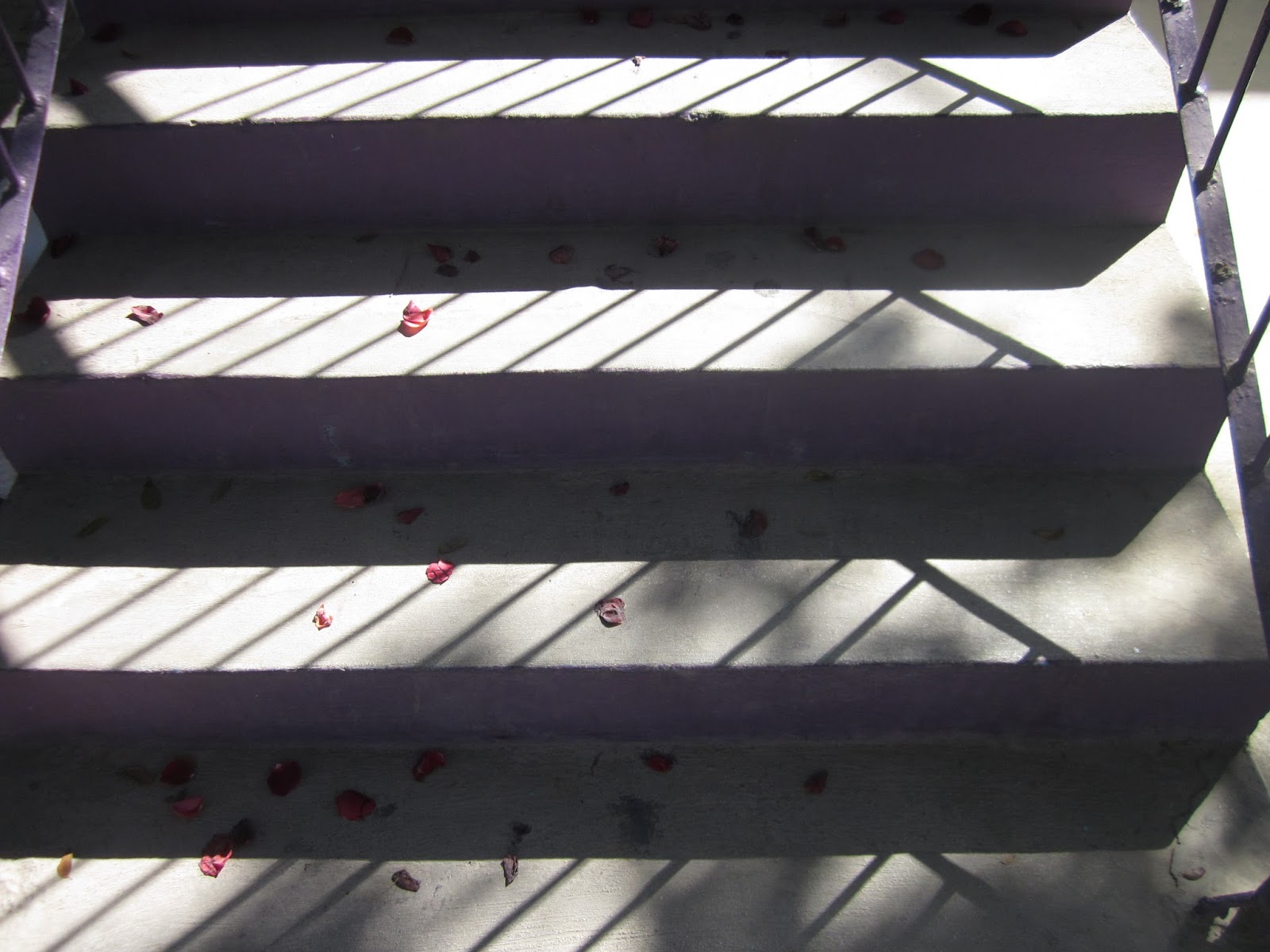
We have all of next week off of school for Carnival (Valentine's Day falls on Ash Wednesday this year), so Poetry Friday is our designated Valentine Substitute Day.  (That's just my name for it, not the official term.)  I am writing this on Thursday evening, but I have experienced enough Valentine's Days in middle school to know exactly how it will go.  It's a dress-down day, with everyone wearing red and pink (our kids normally wear uniforms).  Seniors will be delivering roses.  Candy will be in evidence.  Each of those sentences represents an additional layer of wild, added on to kids who haven't really calmed down from Christmas break yet.  There will be twitterpation, and the Festival of Sugar and Hormones will take place in all its glory.  There will be giggling, and probably some tears.  I will take my annual photos of discarded rose petals on the stairs.  (The photos in this post are the ones I took on February 14th, 2014.)


But it will be OK.  It's the last day before a week off, after all, and we will survive.  And I like celebrating love, so I will work on being patient.

Are you familiar with the concept of Love Languages?  You can learn more about it here, but basically the idea is that everyone experiences love differently, and if you know someone's love language, you can know the best way to help that person know that he or she is loved.  The languages are gifts, quality time, acts of service, words of affirmation, and physical touch.

I tend to mock this idea a little bit because what I have noticed is that usually when I hear women (and it's usually women) talking about love languages, it is because they are complaining that their significant others are messing up.  "My love language is acts of service, but he keeps giving me flowers!" these women will say.  I always feel that if someone's trying to love you, you should notice that part and give credit, even for an imperfect attempt.

However.

It's obvious to anyone who knows me even slightly that my love language is words of affirmation, even though I like all of them, and my husband is very welcome to show me love in all those ways.  But my love language is language.  In any relationship, romantic or otherwise, I like to talk and talk and talk, or write and write and write.  I like feelings to be expressed in words. 

On Wednesday this week, a poem popped into my chat window from my husband.  Not just any poem, but a love poem he had written himself.  I amused myself mightily by how I responded.  My heart raced.  Tears came to my eyes.  People, I've been married almost 29 years.

So here's the poem, posted with his permission.

The Games You Play

My love. I like the games you play.
Washing the Mah Jong tiles,
Building the wall, insisting
On proper protocol.

The mid-game break to brew some tea.
The thoughtful look, deciding whether to
Discard a West Wind, a Dragon, or a lowly bamboo.

And that thoughtful look takes me back
To many of your other looks,
Of wonder, anger, pleasure, pain and joy,
Looks that have, variously,
Thrilled me, frustrated me, confused me, annoyed me
And captured my heart.

Looks that make me want to hold you
And make you smile.

Steve, husband of Ruth, from thereisnosuchthingasagodforsakentown.blogspot.com


I wrote a poem recently about another kind of love, my love for my children.  I had been texting with a new friend (recently married to an old friend), and my poem was partly about our conversation, so after I finished it, I sent it to her, and she reacted in the perfect way that she does, being both an English teacher herself and a very nice person.  She wrote and told me that my poem had brought tears to her eyes.

I shared the poem with my writing group this week, and after I had read it aloud, I sighed and told them that I had shared it with my friend, and that it made me so happy to communicate with someone who is dear to me, expressing what I meant to say.  I said, "I really like this poem," and one of the other members of the group replied, "Yes, I can see why you would.  It's a very Ruth poem."  I laughed later on as I realized she didn't say she liked it; you could take her words in several ways.  But anyway.  I like it, and here it is:

Flying Away

A friend and I text about our children who are traveling.
Her son is delayed somewhere between home and Paris,
and my daughter missed her train in Chicago
between the airport and her dorm room.
We are thousands of miles from our children,
and fifteen hundred miles from each other,
but our love and concern fly through the atmosphere
faster than airplanes.

My son who still lives at home
wakes up taller than when he went to bed
and when I smile at him now I have to look up just a little.
I heard that astronauts grow while they’re in space,
because when there’s no gravity,
their vertebrae expand and relax.
Maybe as he sleeps, the same thing happens to him;
but whatever the explanation,
soon he will fly away too;
oh, not to the moon, but far,
far beyond my reach.

We end our text conversation,
confessing that we are likely to be asleep before
our children reach their destinations.
“We can pray for our kids before we go to sleep,”
she types with her thumbs,
and we both do,
we both send our prayers
flying after them,
through the atmosphere,
through space,
through eternity,
through the night;

letting our vertebrae relax,
and our spines grow,
as these children who grew inside us
fly away.

Ruth, thereisnosuchthingasagodforsakentown.blogspot.com

I'm thankful for love, and for words to express it in, and for people who send me words of love and receive my words in return, with grace and kindness.  I'm thankful for the chance to share beautiful words with middle schoolers who are learning how to express the big feelings they have.  I'm thankful for my writing group and for Poetry Friday, giving me opportunities to share my words with people who appreciate them.  I'm even thankful for the chaos that today will bring as we celebrate Valentine's Day.


Today's roundup is here. (Poetry Friday friends, somehow the combination of Australia and Haiti isn't working so well, and I can't get to the roundup site either to put my link there or to come visit your links.  I'll keep trying!  Meanwhile, I've asked someone to put my link up on the roundup.)

Sunday, February 04, 2018

Reading Update

Book #8 of the year was The Beautiful Mystery, by Louise Penny.  This is the eighth in the Inspector Gamache series, and my favorite so far. 

Book #9 was the bizarre but brilliant Lincoln in the Bardo, by George Saunders.  The Bardo is a Tibetan concept, the idea that souls linger between life and death and that there's some kind of choice involved in whether to move on or not (I actually could not articulate the choice more than that, because I'm a little unclear about it).  Willie Lincoln, the son of Abraham Lincoln, is the latest famous guest in the Bardo, having died of typhoid, but there are many other colorful souls to be met there as well.  It's difficult to summarize exactly what goes on in the book, but I can promise you that you've never read anything quite like it.  The best parts are beautiful and life-affirming.  Here's a sample:

"The way a moistness in the eye will blur a field of stars; the sore place on the shoulder a resting toboggan makes; writing one's beloved's name upon a frosted window with a gloved finger.

Tying a shoe; tying a knot on a package; a mouth on yours; a hand on yours; the ending of the day; the beginning of the day; the feeling that there will always be a day ahead.

Goodbye, I must now say goodbye to all of it."

Book #10 was Intérieurs d'Haïti, by Roberto Stephenson and Marie-Louise Fouchard.  I mentioned in an earlier Reading Update post this year that I wanted to read through some of the art and photography books on my shelves, since doing that makes me happy.  This one has an essay by Frankétienne, a revered Haitian poet, in English and French.  This is followed by a hundred panoramic photographs of the inside of Haitian homes, from the most humble to the most ornate.  The only copies available on Amazon are extremely expensive; I'd be happy to loan you my copy if you come over to my house.

Book #11 was Braving the Wilderness: The Quest for True Belonging and the Courage to Stand Alone, by Brené Brown.  Apparently I'm not the only person who struggles with the issues in this book.  Good to know.  As usual, Brené Brown has written a wonderful book.

Book #12 was Emily P. Freeman's Grace for the Good Girl: Letting Go of the Try-Hard Life.  I have been listening to Freeman's new podcast, and so I could hear her voice as I read the book.  This was a good introduction to my OLW for 2018: ENOUGH.

"The job of the branch is not to make life happen, but to remain in the vine.  To remain in Christ is to stay where you already are.  No need to get up and try to find that which you already have.  Stay.  Abide.  Remain.  Believe."

Book #13 was an old classic, Nevil Shute's On the Beach.  The book opens in 1961, but it's a post-apocalyptic 1961.  We are in Australia, one of the few places left on earth where people are alive.  Soon, the entire planet will be overtaken by radiation and everyone will die.  Sounds uplifting, doesn't it?  Oddly, it is.  I first read this book many years ago, before I moved to Haiti in 1993.  At that time, Haiti was under an international fuel embargo, and I thought many times of this book as I watched people rationing fuel, since that's one of the first problems the characters face.  Later, as the embargo strengthened, and no commercial airlines were allowed to fly to Haiti, I thought more about the book because of the sense of being cut off from the outside world (in those pre-internet days).  But another aspect of Haitian life back then that reminded me of the book was the way people lived every moment, enjoying the pleasures they had available.  As I read this time, I kept thinking that this is really the human condition: unlike the people in the book, we don't know exactly when we're going to die, but we know we will, and it's up to us to decide what to do with the days we have.  I smiled as one character said to another towards the end of the book: "Don't try and analyse it....Just take it, and be thankful."  That's a bit difficult for me, since analyzing (or analysing, as the Australians in the book would spell it) is my second nature, but I'm trying to do more of just taking my life, and being thankful. 

This post is linked to the February Quick Lit roundup at Modern Mrs. Darcy.


Friday, February 02, 2018

Poetry Friday: I Can't Forget You

I read this poem with my eighth graders last week.  I got it from the Nancie Atwell anthology for middle school, Naming the World: A Year of Poems and Lessons.  It looks as though it's out of print and only available for outrageous prices, but if you teach middle schoolers and you have access to the book, you should definitely grab it.  The vast majority of the poems work well with my kids.  There are many student-written examples, and a fun variety of published poets.  Each poem comes with a page of ideas on how to approach it with your students, including Nancie's "benediction" that encourages the kids to try something out in their own writing. 

This one is one of my favorites, because it's so relatable for my students.  They know graffiti; it's ubiquitous in Port-au-Prince.  They respond well to the idea of noticing something and wondering how it came to be.  And they know what it's like to miss someone. 

I CAN'T FORGET YOU.

spray-painted high on the overpass,
each letter a good foot long,
and I try to picture the writer
hanging from a rope
between midnight and dawn,
the weight of his love swaying,
making a trembling
N and G, his mind at work
with the apostrophe -
the grammar of loss -
and his resistance to hyperbole,
no exclamation point but a period at the end
that shows a heart not given
to exaggeration,
a heart that's direct with a no-
fooling around approach,
and I wonder if he tested the rope
before tying it to the only tree I can see
that would bear his weight,
or if he didn't care about the free-
fall of thirty or more feet
as he locked his wrist to form such
straight T's,
and still managed, dangling, to flex
for the C and G,
knowing as he did, I'm sure,
the lover would ride this way each day
until she found a way around,
a winding back road with trees
and roadside
tiger lilies, maybe a stream, a
white house, white fence
a dog in the yard
miles
from this black-letter, open-book,
in-your-face missing
that the rain or Turnpike road crew
will soon enough wash off.

Len Roberts
Here's the Poetry Foundation link to the poem.

Such amazing details!  I especially love the apostrophe, and the lack of an exclamation point.  And that phrase: "the grammar of loss."  Someone should write a novel with that title.

And while I'm waiting for someone to do that, here's very much a first draft of a poem playing with the idea.


The Grammar of Loss

is in the perfect tense,
of course,
because the past was perfect,

and there are
apostrophes
on the names
because it’s all about
belonging,

or used to belong,

in the past,

instead of this moment
when
it's over,

this present tense moment
where

whatever
or
whoever
you lost

is absent,

a misplaced modifier,
a split infinitive,
an interrogative,

missing
from a dependent clause,

a subject and verb
no longer agreeing,

a fragment.

Ruth, thereisnosuchthingasagodforsakentown.blogspot.com

By the way, speaking of fragments, if anyone is keeping track of my Quinquagenarian Writing Project (#QWP), in which I attempt to write 50 first drafts between last July and my February birthday in a couple of weeks, when I'll become a quinquagenarian, I'm up to 44 first drafts.  So, yay me! 

Donna (who's doing a lot of hosting lately) has today's roundup.


Thursday, February 01, 2018

Spiritual Journey Thursday - The Moon

     "I have been given the gift of lunar spirituality, in which the divine light available to me waxes and wanes with the season.  When I go out on my porch at night, the moon never looks the same way twice.  Some nights it is as round and bright as a headlight; other nights it is thinner than the sickle hanging in my garage.  Some nights it is high in the sky, and other nights low over the mountains.  Some nights it is altogether gone, leaving a vast web of stars that are brighter in its absence.  All in all, the moon is a truer mirror for my soul than the sun that looks the same way every day.
     After I stopped thinking that all these fluctuations meant that something was wrong with me, a great curiosity opened up: what would my life with God look like if I trusted this rhythm instead of opposing it?  What was I afraid of, exactly, and how much was I missing by reaching reflexively for the lights?"
from Learning to Walk in the Dark, by Barbara Brown Taylor


Today's hostess of Spiritual Journey Thursday, Donna, has asked us to write about the moon.  I immediately turned to Barbara Brown Taylor, and her beautiful book on darkness.  I have often felt, as Robert Frost put it, "acquainted with the night," and Taylor's book helps me work through some of those thoughts.

Here she is again:

"If Christians look to creation for wisdom about the spiritual life, seeking resurrection in springtime, divine promise in a rainbow, or the flight of the Spirit in a dove, why don't we look to the moon for wisdom about our relationship to God?  Sometimes the light is coming, and sometimes it is going.  Sometimes the moon is full, and sometimes it is nowhere to be found.  There is nothing capricious about this variety since it happens on a regular basis.  Is it dark out tonight?  Fear not; it will not be dark forever.  Is it bright out tonight?  Enjoy it; it will not be bright forever."

It was bright out tonight, as the super-duper Blue Blood Supermoon came up.  I tried and failed to take decent photos of it.  But at least I saw it, and it was so beautiful, and turned my mind up to a higher plane than the one it had been occupying.

On a slightly less spiritual note, I wrote the following golden shovel poem/prayer back in November.  (See, it is spiritual - it's a prayer!)  A golden shovel poem takes a quote (in this case, a line from Paul Simon's song Insomniac's Lullaby) and ends each line with a word from the quote.


Insomniac’s Lullaby

Awake in the middle of the night and oh
I wish you’d let me sleep, Lord!
Here comes slithering every mess I ever made (don’t
Surround me with your tentacles, keep

Your slimy horrors away from me!).
Nobody else in the whole world is up
Except for me, and now I have to face it all:
All my mistakes, all my losses, the darkness of night,

They all approach me, side by side.
Till morning, I’ll be in deep conversation with
Everyone who’s ever abandoned me, the
Whole sorry scene lit bright by the silvery moon.
Oh Lord, don’t keep me up all night
Side by side with the moon


Ruth, thereisnosuchthingasagodforsakentown.blogspot.com

(I posted about this song before here, including a YouTube video where you can listen to it.) 

Here's the Spiritual Journey Thursday roundup.

Wednesday, January 31, 2018

What I Learned in January

Several of my favorite bloggers post regularly - monthly or quarterly - about what they have learned.  I thought, at the beginning of this year, "What a good idea.  Let me write about my learning, too!"

I started a list.

In church we have been studying the book of Leviticus, and discussing the sacrificial system in the Old Testament.  I admit I was not initially thrilled by this choice, but I have been learning every week from the conversations around our Table.

For some reason, I put the word mordicus on my list; this is a French adverb meaning "with an opinionated firmness."  I'm sure I learned other words this month, but that is the only one I carefully wrote down under the heading "What I Learned in January."

I learned about Oprah Winfrey and her TV career this month by listening to the interesting podcast series "Making Oprah."

I learned that in this season of my life, it works better for me to exercise first thing in the morning, right after I wake up.  I had been working out right after getting home in the afternoon, but that hasn't been happening for a while (I'm embarrassed to say how long).  This month my workout calendar filled up, and there are many more days I did exercise than days I didn't.  I will never be an athlete, but this is progress.  I feel so much better when I'm exercising regularly; I know this, and yet I fall off my routine again and again.  This new routine has worked well in another way, too; I have been listening to uplifting podcasts instead of what I was doing before, which involved a fair amount of brooding over the world and its current condition, and all the things I can find to be sad about.

I learned what the President of the United States allegedly thinks of this country, Haiti, where I have lived for more than twenty years, where my children were born.  Worse, I learned that many Americans agree with the words, whether he actually said them or not.

An eighth grader's quiz, where she announces her intention to interview the President of Haiti about what the President of the United States allegedly said.

After that my list ends.  That's not because I didn't learn anything else, but because I did, and because I started to get discouraged that I need to keep learning the same lessons again and again.  In January, I learned how clumsy I can be about people and relationships.  I learned that emotionally I am a little too much like my thirteen and fourteen year old students and not enough like the staid, sensible middle-aged woman with everything figured out that I am supposed to be.  I learned that people leave, and it hurts.  It just hurts to love people, period.

I already knew all these things.

Other people post helpful advice, apps that will organize your life, wise thoughts.  Maybe in February I can learn some of that.  We'll see.

Friday, January 26, 2018

Poetry Friday: Not Enough, Too Much, Just Right, and Happy News At the End

I wrote this poem several years ago, but it came to mind as I was thinking about my OLW for 2018, ENOUGH.  During the course of this challenging week, I have had plenty of moments that would fit into the first two stanzas: Not Enough and Too Much.  There aren't that many moments I can identify that would belong in the third.  Can I consider myself Just Right if I showed up and did my best?  Can I ever let that be ENOUGH?  Working on it...

I shared this poem with my writing group this week, and someone said it felt "crowded."  I can see that, and I even agree with it, but this is one of those times when I feel as though what I wrote completely expressed what I meant to say.  It would probably benefit from some editing, but I like it the way it is.   Maybe I'll come back and work on it some more later, but for now, I'm going to call it Just Right.


Not Enough, Too Much, Just Right

Often I am Not Enough.
Not patient enough or pretty enough,
Seeking constant reassurance
From the mirror of other people's eyes:
Do you love me?  Huh?  Do you?
Not knowing what to say
Or which fork to use,
Wearing jeans to the ball,
Not hip or cool enough,
Missing the point, holding back
Until the moment is past.

More often I am Too Much.
Too many words
Escaping even though I clamp my lips shut,
Hips too big, feet too clumsy,
Clomping around stepping on toes.
I call and text and email all day long:
I love you I love you I love you!
Too much laughter and too many tears,
Too much messy overgrown emotion,
A jungle that overwhelms any explorer.

But sometimes, ah, sometimes
I am Just Right.
Giver of a moment of complete satisfaction,
Purveyor of breastmilk at just the right temperature
To soothe a fretful baby.
I say the right thing sometimes
And understand exactly:
That's just what I meant!  How did you know?
I love and am loved with perfect equilibrium.
I'm an earthly angel, having a good hair day,
I am Baby Bear's porridge:
Just Right.

Ruth, thereisnosuchthingasagodforsakentown.blogspot.com


By the way, a happy thing, extremely welcome in this aforementioned challenging week, happened yesterday.  I got an email letting me know that one of my poems is going to be in an anthology.  This is the first time for me, and it feels very good.

This week's roundup is here.

Monday, January 22, 2018

QWP Update

Since my last update on my Quinquagenarian Writing Project, in which I'm attempting to write 50 first drafts before my 50th birthday, I have made quite a bit of progress.  I'm now up to 40, with about five weeks left.