Friday, November 15, 2019

Poetry Friday: First Frost

Here in Haiti this fall of our discontent drags on. We are still not having school, still sitting at home smelling burning rubber as angry protestors man flaming barricades and demand that motorists pay for the privilege of passing. This week was a bit calmer in our area, but not in other parts of the city and the country.

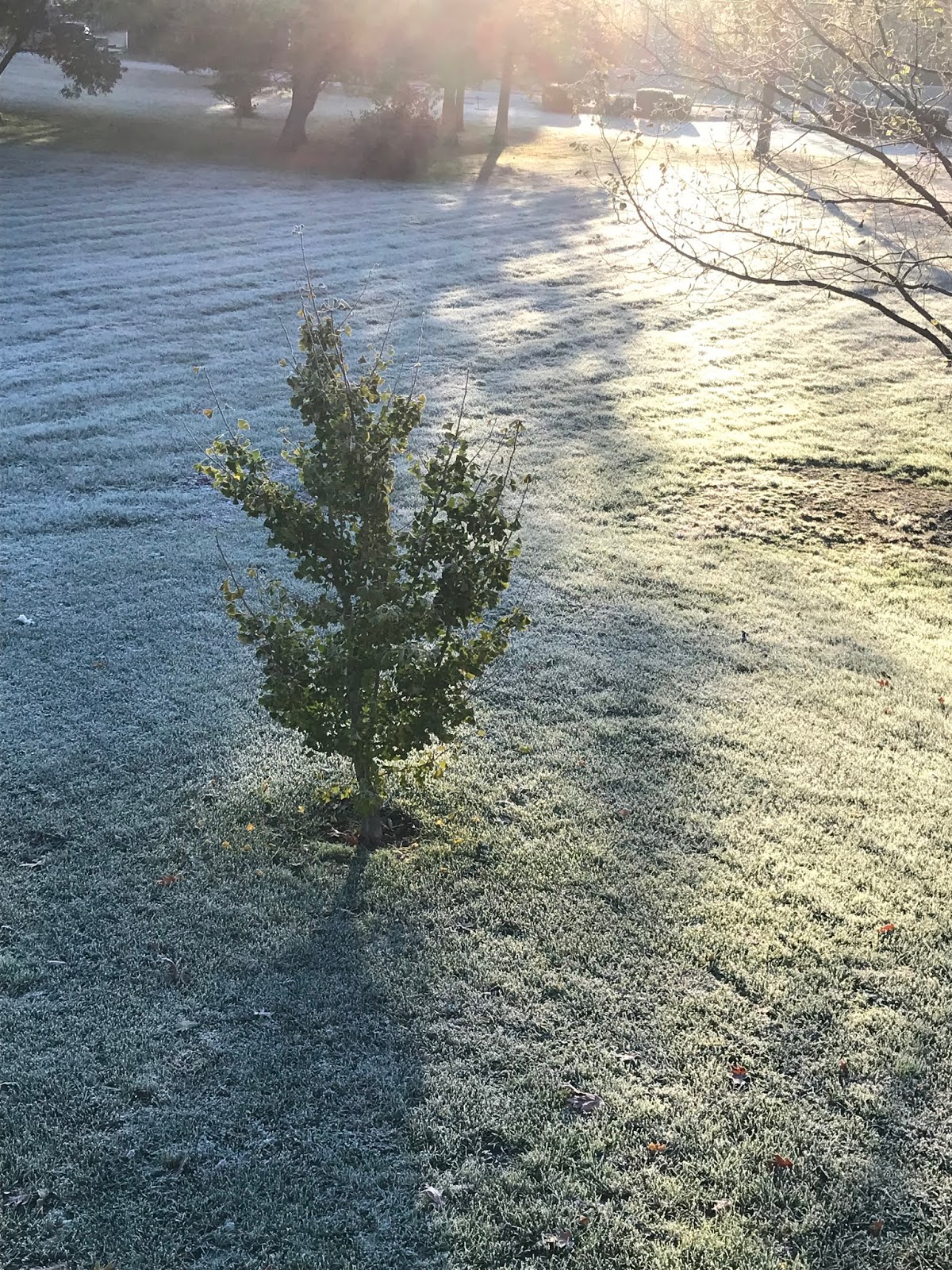
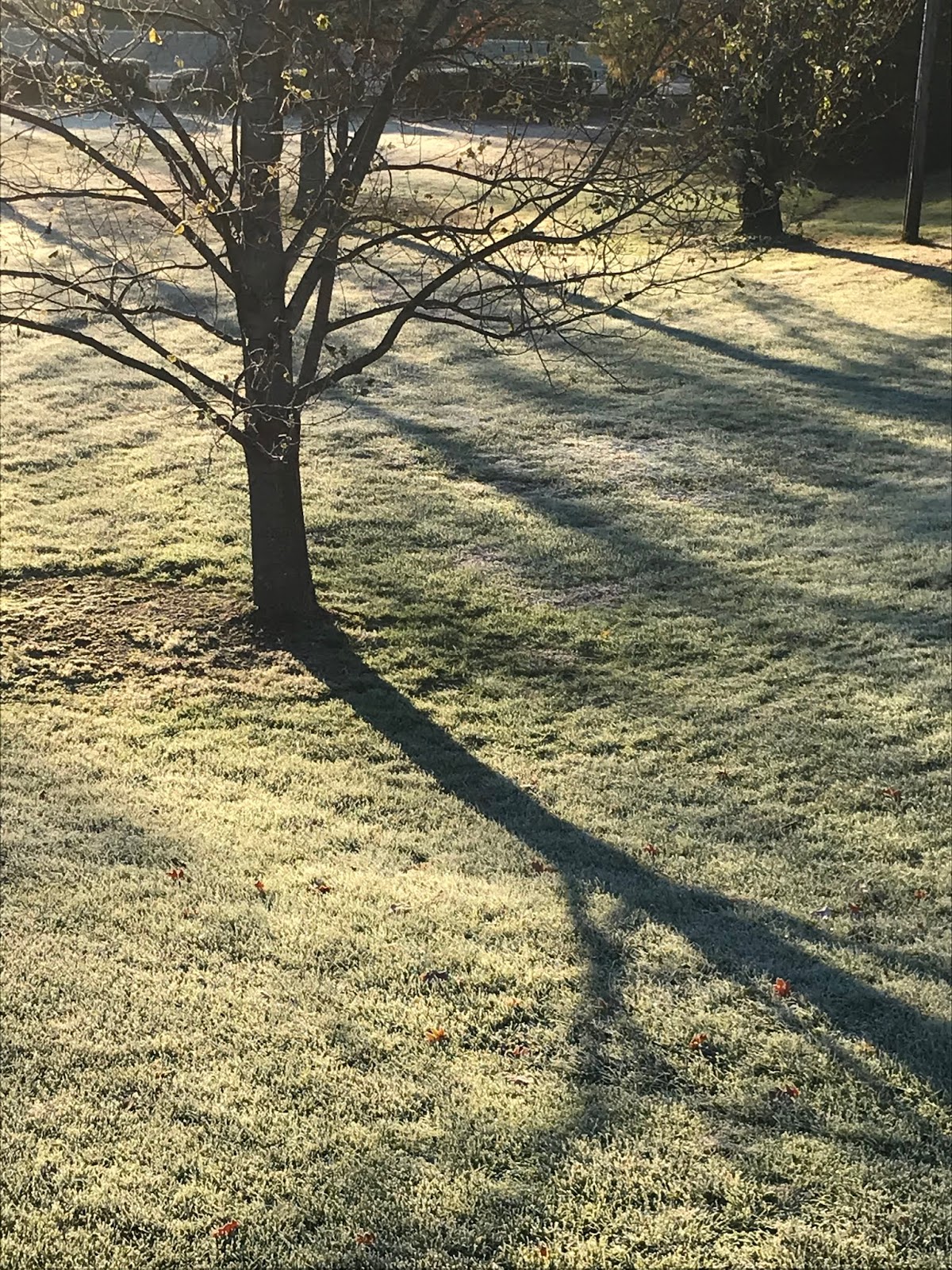
Meanwhile, far north of here, winter seems to be getting an early start. A friend took some photos of the first frost and sent them to me, and it felt so good to think and write about something other than what's going on here (my largely stalled NaNoWriMo project, like my life, consisted of Haiti topics). I got permission to share the photos along with my poem.

First Frost

Into my tropical reality
comes a glimpse of another world,
a stillness before the day’s business begins,
first frost,
every surface edged with a fuzz of ice,
your mother’s tree outlined with a fringe of cold,
the garden hose lying idle,
the withered yellow flower that somehow still manages beauty
and you, crunching across the grass to document it,
following the visible puffs of your own breath,
taking dozens of pictures to freeze this moment
because, like all moments,
it will thaw and pass away.

Ruth, from thereisnosuchthingasagodforsakentown.blogspot.com

Another reminder that life goes on in spite of the stalled political, economic, and educational situation here in Haiti came this week with a transmission from Nokomis, the great blue heron banded in Maine who likes to spend her winters here in the sunny Caribbean. (Here's my post and poem about her from exactly a year ago today.) She hadn't been heard from in a while, but now they found out that she's in Cuba and on her way south.
Source: Heron Observation Network of Maine

And another thing happening the way it's supposed to: today's Poetry Friday roundup! Head over there to see what people are sharing today, and to join in the celebration of the arrival of The Best of Today's Little Ditty: 2017-2018!

Friday, November 08, 2019

Poetry Friday: An Incomplete Picture

I read an article this morning with the headline: "International Media Often Paints an Incomplete Picture of the Situation, says Haitian Studies Association." It's not really surprising that that should be the case. Every picture is incomplete; every sound byte is from one person's perspective; every opinion is formed by one person's experience.

Like everywhere else, most people aren't as concerned with the politics as with their daily struggle to get to work, to earn a living, to provide for their families. Some people feel strongly; presumably they are the ones out demonstrating. Others are just waiting to see what will happen and don't necessarily think that a change of who's at the top will change their lives much one way or the other. I've heard people speak passionately on both sides of the current struggle, and each one was giving an incomplete picture.

Right now children in Haiti can't go to school. Businesses can't function normally. Hospitals can't treat people. Yesterday in my area things seemed almost normal, but then I talked to someone who had taken two hours to get to work (about seven miles), and she said they had to weave around all different back roads and cross several barricades (sometimes paying for the privilege).

Here's a six minute video in English giving some background.

Even in my own head and heart, any moment is an incomplete picture. Sometimes I feel hopeful and encouraged. (A student sent me some writing that was such a good start!) Sometimes I am discouraged and can't see any hope anywhere. (I got an email from an administrator at work with the word "predictable-ish" in the subject line!) I read about street merchants having their artwork cut up and burned by protesters. But I also had a chai party with a bunch of colleagues and people were speculating that maybe the worst was over already. Yesterday I read about people getting burned by an attack on public transport (both sides blamed the other). But then also yesterday, there was traffic out and "people were timidly resuming their activities," as the local media always expresses it. (I love that word "timidly" because it really is perfect. You can sense the tension everyone is experiencing, and people are ready to run and hide at a moment's notice.)

And today I saw a bird in my yard that I'm pretty sure was this guy:

Like the timid people in the streets, he flew away when I attempted to examine him a bit more closely.

It's all partial and incomplete.

I've been trying to do NaNoWriMo, with very limited success. I'm to the point where I hate everything I write and know for a fact that I have no words worth reading. Since my own writing is going so badly, here's someone else's for Poetry Friday this week. As Douglas Dunn says in this poem, "I Am a Cameraman," each sentence of mine "shrugs off every word I try."

I Am a Cameraman
by Douglas Dunn

They suffer, and I catch only the surface.
The rest is inexpressible, beyond
What can be recorded. You can't be them.
If they'd talk to you, you might guess
What pain is like though they might spit on you.

Film is just a reflection
Of the matchless despair of the century.
There have been twenty centuries since charity began.
Indignation is day-to-day stuff;
It keeps us off the streets, it keeps us watching.

Film has no words of its own.
It is a silent waste of things happening
Without us, when it is too late to help.
What of the dignity of those caught suffering?
It hurts me. I robbed them of privacy.

My young friends think Film will be all of Art.
It will be revolutionary proof
Their films will not guess wrongly and will not lie.
They'll film what is happening behind barbed wire.
They'll always know the truth and be famous.

Politics softens everything.
Truth is known only to its victims.
All else is photographs - a documentary
The starving and the playboys perish in.
Life disguises itself with professionalism.

Life tells the biggest lies of all,
And draws wages from itself.
Truth is a landscape the saintly tribes live on,
And all the lenses of Japan and Germany
Wouldn't know how to focus on it.

Life flickers on the frame like beautiful hummingbirds.
That is the film that always comes out blank.
The painting the artist can't get shapes to fit.
The poem that shrugs off every word you try.
The music no one has ever heard.


Irene has today's roundup.

Thursday, November 07, 2019

Spiritual Journey Thursday: Saints

Today our host Margaret asked us to reflect on the subject of saints. I become more interested in saints all the time; not just the ones the church has designated as saints, but the people around us, alive and dead, whom scripture calls the "great cloud of witnesses."

Here are the two songs that come to mind most when I think of saints.


Great Cloud of Witnesses
by Carolyn Arends

I was just four, my grandmother’s place
I knelt by her sofa and started this race
And now I’ve been running for such a long while
I’ve kind of lost track of the miles
Sometimes I press on, sometimes I look back
Sometimes I just lie in the road on my back
When I’ve got to get up and I don’t know how
I hear in the distance the roar of a crowd

It’s the great cloud of witnesses
Cheering me on each step that I go
It’s the great cloud of witnesses
They say the finish is worth every inch of the road

Moses is there, up in his seat
With my Grandad Wilfred, my Nana Bernice
There’s Abraham, Isaac and my buddy Rich
And I think they’re shouting "Don’t quit!"

So if you are tired, and your back is sore
If you’re not so sure you can run anymore
Then just take a moment and listen real close
Do you hear a sound like a heavenly host?

It’s the great cloud of witnesses
Cheering us on each step that we go
It’s the great cloud of witnesses
They say the finish is worth every inch of the road

It’s friends and relations and each generation of saints who believed
And received The Prize
They have looked into His eyes

It’s the great cloud of witnesses … 

This world is so full of discouraging facts, but I am thankful for the people I can look at as inspirations, role models, sources of encouragement, those people who are following our progress, praying for us, thinking the best of us and for us. 

Wednesday, November 06, 2019

Reading Update

The image above was posted on Facebook this week by Pascal Antoine, Founder and President at Haitixchange. I loved the sentiment it expresses. The Kreyol text says: "A locked-down country doesn't mean a locked-down mind. Take advantage of the opportunity to learn something new and make yourself better." (Peyi lock is what people are calling the current situation in Haiti, when we all stay home due to streets blocked with burning barricades.)

This is the Haitian way; make the best of things. I've seen it again and again during my time here. People don't sit around and mope; they get up and hustle and provide and try and keep trying. After the earthquake, I read this post about a new phrase, "Haitian up." "Hospital workers," reports the article, "say they've rarely seen patients so stoic in the face of horrific loss and adversity. 'We've created the phrase "Haitian up," says Dr. Justine Crowley, meaning, 'toughen up or buck up.'"

I have been trying to follow the advice to Haitian up and learn something new, and one way I do that is by reading books. I am very aware of the layers of privilege that have allowed me to spend large chunks of my extra time in these days reading. I have an education; I have access to books in my first language; I have enough to eat and drink to provide me with energy I need; I am healthy.

Here are some books I've been reading lately.

Book #93 of 2019 was Hannah Coulter, by Wendell Berry. My friend Janet, who wrote and published her dissertation on Wendell Berry, recommended this book in an email exchange about our daughters going to college and ways to navigate this enormous life change. This was my first Wendell Berry novel, and it won't be my last. "I began to know my story then," says Hannah when she loses her first husband. "Like everybody's it was going to be the story of living in the absence of the dead. What is the thread that holds it all together? Grief, I thought for a while. And grief is there sure enough, just about all the way through. From the time I was a girl I have never been far from it. But grief is not a force and has no power to hold. You only bear it. Love is what carries you, for it is always there, even in the dark, or most in the dark, but shining out at times like gold stitches in a piece of embroidery. Sometimes too I could see that love is a great room with a lot of doors, where we are invited to knock and come in. Though it contains all the world, the sun, the moon, and stars, it is so small as to be also in our hearts. It is in the hearts of those who choose to come in. Some do not come in. Some may stay out forever, some come in together and leave separately. Some come in and stay, until they die, and after....I am there with all the others, most of them gone but some who are still here, who gave me love and called forth love from me. When I number them over, I am surprised how many there are. And so I have to say that another of the golden threads is gratitude."

Books #94, #95, and #96 were the Daughter of Smoke and Bone trilogy, by Laini Taylor. (I read these on my Kindle, but the only link I can find to the trilogy is a boxed paperback set). I read these several years ago, and enjoyed them again the second time through. I really appreciate Laini Taylor's storytelling skill. Her characters are so believable, which is an odd thing to say about monsters and angels and people of other worlds, but a true thing. The story is absorbing and as such, a perfect series to read during my current life situation.

Book #97 was The Horse and his Boy, by C. S. Lewis. I've been reading this series since I was seven years old. These are the books I turn to when I need a comfort read.

(Quotes from the illustrations, in case you can't read them: "Don't speak to me, don't speak to me," said Tumnus. "I'm thinking. I'm thinking so that I can hardly breathe.Wait, wait, do wait." And then later, this perfect description: "One of the drawbacks about adventures is that when you come to the most beautiful places you are often too anxious and hurried to appreciate them; so that Aravis (though she remembered them years later) had only a vague impression of grey lawns, quietly bubbling fountains, and the long black shadows of cypress trees.")

Book #98 was A Better Man, by Louise Penny, the latest Chief Inspector Gamache novel. I like but don't love this series. I'm sure I'll read the next one, too.

Book #99 was Reckless in Red, by Rachael Miles. The author of this series, the Muses' Salon Series, is a friend from graduate school. I enjoy her knowledge of the period; a favorite scene in this book was the gathering of women discussing the recent revision Coleridge has put out of Rime of the Ancient Mariner. Other things I loved: the way the main character imagines everyone she meets as part of a painting, the plot twist involving grave robbery, the shop called The African's Daughter, run by Constance Equiano (I hope she'll be writing a book where this character is the protagonist).

Book #100 was John James Audubon: The Making of an American, by Richard Rhodes.
It took me a long time to read this book, not because I wasn't enjoying it, but because I so often reach for my Kindle instead of a giant book. My Kindle easily goes with me from place to place; it's lightweight and doesn't take up a lot of space. I can read it when I wake up in the night without turning on a light and waking my husband because it's backlit. In principle I prefer real books, but in practice I am afraid I am very much a convert to reading on the Kindle.

I liked this book so much, and learned so much from it. I am interested in Audubon for obvious reasons: he was born in Haiti and he loved birds so much that most people know his name today as the name of a bird conservation organization. My favorite quote from the book is from a letter to his wife, from whom he was separated for years by his work on his masterpiece Birds of America. "'For God's sake, my Lucy,' he added passionately, 'do not be troubled with curious ideas such as my liking the birds better than thee, &c., &c., &c. Come and be mine.'" The subtitle, "The Making of an American," refers to Audubon's life-long efforts to make himself part of his adopted country. (Another way to put that would be his life-long efforts to hide his origins. More on that fascinating topic can be found in this article, "Audubon's Haiti.") Audubon was forced by the prevailing culture of the day to be ashamed of his mixed race heritage and lived in fear of someone finding out.

One of the main reasons I read biographies is to learn about the struggles the subjects had. We all know what people are famous for, but a biography can show you more about what people worried about, what their financial issues were, how they failed, whom they loved. Audubon was a remarkable, one of a kind man, but he also had many problems. That he succeeded with his amazing achievement, Birds of America, is a testament to his perseverance and hard work. He had such a vision for what he wanted to do, and he just kept at it, even when those closest to him didn't really get it. He kept improving his artistic technique and knowledge. And he did like the birds. I don't know if he liked them more than Lucy, but it was at any rate close. It's so inspiring to read about someone motivated by a genuine passion for a scientific subject.

The other thing that I will remember from this book is Audubon's descriptions of the enormous bounty of wildlife when he was discovering America for himself. Again and again he tells of scenes where there were thousands of birds. Some of these birds are now extinct; the survivors exist in far smaller numbers today. Audubon saw it happening in his own lifetime. It's just heartbreaking to see what our ancestors did to slaughter everything they found. Audubon killed too, but at least he did it to preserve. We owe so much of what we know about birds to him.

I'm so thankful that these books are helping me get through this time of peyi lock. I'm going to keep reading! Send me suggestions for books you think I'd like!

Friday, November 01, 2019

Poetry Friday: Lockdown Yoga

My friend Alexis Kreiner wrote this poem when friends in the US kept telling her to do plenty of self-care during this lockdown in Haiti. Specifically, many suggested yoga. Alexis says she doesn't ever write poetry, but she just couldn't bypass this opportunity. Thanks for letting me share it, friend!

If you don't live in Haiti, you won't fully appreciate all Alexis' clever references, but you will pick up on the fact that all of us here in Haiti are tired of lockdown and want to go back to our regular lives.


DO YOGA, THEY SAID (by Alexis) Welcome, To lockdown yoga, A manifestation, Of mindfulness, Attempted self-care, And deliberate ignoring. To begin, We inhale, The charcoal smoke, From the neighbor, And we exhale, All plans for the week. We bend, Forward to the mat, Stretching the muscles, Beginning to atrophy, From Netflix "self-care." We sit, Cross-legged now, Raising our arms, Above as a flame, We call this one, The 'burning tire.' We descend, Back lying on mat, Legs outstretched, We move now, Into my favorite pose, The 'road barricade.' We raise, Our aware bodies, Bringing our focus, To the present, While fully ignoring, The shots fired. We lift, Arms above head, Slowly leaning back, Going steeper, And painfully long, Just like the weeks. We bring, Ourselves back, To our center place, Stretching shoulders, Holding in core, And desire to scream. We pretend, This helps something, Stops the rocks, Flying at windows, Angrily claiming this, Self-care damn it. We thank, Our tense bodies, And high lakou walls, And admit honestly, Feeling more stressed, By lockdown yoga.

Tabatha has today's roundup. 

Friday, October 25, 2019

Poetry Friday: Still More about Windows

Three years ago, I wrote for Poetry Friday about reading the poem "After the Blizzard, Outside My Window," by LeslĂ©a Newman, from the Poetry Friday Anthology for Middle School, with my seventh graders. They surprised and amused me with their reaction, and I wrote a sonnet, "Why I Can't Look out the Window," about what they said. Then last year, I shared my sonnet plus another poem, "Out the Window," that I wrote about the next year's seventh graders' comments in a class discussion on what was outside their windows.  Most of them said there was absolutely nothing interesting outside their windows, but I found their Haitian views interesting.

This year, I was looking at my window poems and thinking about what children can see out their windows in this time of unrest and confusion in our island home. Many children are sitting at home now with little to do but look out the window, since thousands of schools all over Haiti are closed. Those who look out may find burning tires, large groups of demonstrators, clouds of tear gas. Everything beautiful is still there, too, but sometimes it's hard to see it.
A bird outside a window at my house; I believe it's a gray kingbird.

As I was contemplating these thoughts and a possible poem, my husband sent me some images that have been making the rounds on social media. They show people covering windows with concrete blocks. It's typical here to protect windows, whether in homes or businesses, with metal bars, but apparently these stores wanted more; rioters have been breaking windows with rocks, so it may not be a bad idea. Windows are expensive to replace. But windows are also designed to see through.

I wrote this poem in response:


Block it Up

Block it up,
cover the glass
with concrete,
protect what’s inside
from angry crowds,
turn the window
into a wall.

Block it up,
block it up!

How will anyone see in?
How will anyone see out?

It doesn’t matter!
Better closed than smashed!
Better blocked than vulnerable!

Something there is that loves a wall.

Block it up!

Ruth, from thereisnosuchthingasagodforsakentown.blogspot.com


Oh, friends, what a struggle it is to figure out how far to be open, and how far to protect ourselves and stay safe! I mean that in every possible way from entirely metaphorically to extremely literally.

Today, on this Poetry Friday, the Catholic church in this country has called for a day of prayer and fasting for an end, with peace and justice, to the crisis in Haiti. If you're so inclined, we would welcome your participation. We're tired and ready for the walls of separation to come down. We're ready to see better things when we look out the window.

Karen Edmisten has the roundup today.

Thursday, October 17, 2019

Poetry Friday: Catching Up

Due to Haiti's political situation, I've been spending many days at home over the past few weeks. One thing I've done to pass the time is listen to podcasts. One of my favorites is The Slowdown, hosted by the last Poet Laureate of the United States, Tracy K. Smith. Because it's daily, I quickly get way behind, but this week I listened to a lot of them, and I wanted to share a few of the poems I especially enjoyed.

The Boatman, by Carolyn Forché

Europa Nostra, by Nathalie Handal

What Does It Say, by Tess Gallagher

Haiku, by Etheridge Knight


Jama has the roundup today, so you can be sure there will be good snacks! Happy Friday!

Saturday, October 12, 2019

Reading Update

One advantage of not going to work and in fact hardly venturing beyond one's front gate is having extra time to read. Please send me suggestions of low-stress books to read. Funny books? Cheerful books? Absorbing books that will make me forget what's going on around me? Particularly books that I can download for free from the public library in the US that I frequent from afar? Leave them in the comments, please and thank you.

Book #80 of 2019 was Winter Morning Walks, by Ted Kooser. These are poems Kooser wrote and sent his friend Jim Harrison on a postcard. They are lovely and evocative and made me want to go on walks. (Here's a Poetry Friday post I wrote including a poem from this book.)

Book #81 was The Buried Giant, by Kazuo Ishiguro. I didn't get this book at all, and had to force myself to finish it (because we're going to discuss it in my book group). The fault probably lies with me, because many other people have liked it a lot.

Book #82 was a re-read, Invitation to Tears: A Guide to Grieving Well, by Jonalyn Fincher and Aubrie Hills. I wrote a little bit about it here.

Book #83 was another re-read, Flight Behavior, by Barbara Kingsolver. I read it aloud to my husband, and we both liked it. I am a big Kingsolver fan, but reading this aloud made the didactic elements of the story stand out to me more than they did when I read it silently. I wrote about this book here back in 2013.

Book #84 was an old favorite, Persuasion, by Jane Austen. In spite of the troubles, two friends came over and we drank tea and talked about this book, and that was just what I needed. Incidentally, this time of reading it, this novel seems much more about dealing with difficulties than I had realized in the past. Anne's inability to have agency in so many of her life choices felt more stifling to me than I remember.

Book #85 was Aerie, by Maria Dahvana Headley. This was a sequel to Magonia, reviewed here. I really liked it, but I thought it was quite talky and I couldn't picture my students having the patience for it.

Book #86 was Educated, by Tara Westover. I had this book on hold at the library for months and months, and finally it came through. I enjoyed reading it but found the descriptions of abuse difficult. It's an amazing look at how you can live in a subculture and be completely unaware of the outside world and the way others see things. I also appreciated Westover's reflections on how memory works and how she gradually became able to look at her past with more and more courage and honesty. Recommended.

Book #87 was The Last Anniversary, by Liane Moriarty. I liked this pretty well; it kept me reading.

Book #88 was The Penderwicks: A Summer Tale of Four Sisters, Two Rabbits, and a Very Interesting Boy, by Jeanne Birdsall. This was a recommendation from a friend for a comforting read (kind of like what I asked for in the first paragraph of this post). I enjoyed it, and the only thing that would have improved it for the purpose would have been if I had already read it when I was a tween.

Book #89 was The Voyage of the Dawn Treader, by C. S. Lewis. This is the ultimate comfort read, tried and true. It's the first book I read after the earthquake. When I decided I needed to read it, though, I couldn't find it. My son informed me, after hunting in my daughter's room, that all of C.S. Lewis' other books were in there, but not that one. I put out a lament on Facebook, and the next day a friend delivered a copy. It was just the ticket.

Book #90 was another re-read, Night of Cake and Puppets, by Laini Taylor.

Book #91 was a re-read, The Return of the Prodigal Son: A Story of Homecoming, by Henri Nouwen. I really liked this the first time I read it, but this time it just depressed me. I'm sure the fault is with me and not the book.

Book #92 was another read-aloud to my husband. It was written by a schoolmate of his from Japan and it's called Growing Up Gaijin: An American Kid in 1960s Japan, by Ladd McDaniel. My husband and I enjoyed this very much; it was enough removed from our current surroundings to be relaxing and fun to read, and there was a lot in it that he could relate to, having also grown up as an American kid in Japan in the 1960s.

Friday, October 11, 2019

Poetry Friday: Fire

Today I will stay home and grade student assignments and send out encouraging notes and work on cheerfulness because things could be much worse. Four weeks of lockdown here in Haiti, but I haven't been hungry and the weather is lovely. Nobody is dropping bombs on me, and that's not something everyone can say. We even got to have two half-days of school this week (and they were wonderful).

And yet...

Usually I have an idea about midweek of what I want to post for Poetry Friday, but this week I woke Friday morning not knowing. I went to Poetry Foundation to find something. Let's see, how am I feeling today, I asked my fingers, and they idly typed in: "Anger." "Rage." "Fire."

Whoa.

So anyway, here's a poem I found to post.

Fire and Ice
Robert Frost

Some say the world will end in fire,
Some say in ice.
From what I've tasted of desire
I hold with those who favor fire.
But if it had to perish twice,
I think I know enough of hate
To say that for destruction ice
Is also great
And would suffice.

Here is a poem I wrote called "Fire." I wrote it during another time of unrest in Haiti.

Here is today's roundup.

Friday, October 04, 2019

Poetry Friday: Lockdown

So as I've mentioned in my last couple of posts, we are in lockdown status here in Haiti. Yesterday we had a half day of school - the first this week - but today we are out again, due to huge protests that are supposedly going to take place. Protesters are marching in the streets with the goal of getting the current president to resign. In the process there has been a lot of burning and looting and general chaos. Plus, the whole country has basically shut down; people aren't going to work or school, and we're all waiting to find out what happens next.

We've been attempting to continue classes by using various online tools, and in some ways I feel as though I am just pretending things are normal. For example, today is the due date for final copies of all writing in my middle school classes, and I'm trying to stick to the due date. What that means is that I'm sitting in my classroom on the almost abandoned campus, because our internet at home isn't working. (Haiti runs on imported fossil fuel. There are fuel shortages. Nothing is working correctly.) It doesn't matter; I'm still reading students' work and putting down grades. Better to grumble under my breath about punctuation errors than about things falling apart around me.

On Wednesday, when the internet was working, I was texting with C., a friend here in Haiti. (She's also in my writing group.) I told her I was getting frustrated with life in lockdown. She suggested that I make something.  She said she'd made bread and kombucha, and was feeling much better as a result. I told her I'd make a poem, and she agreed that would probably work, too. Then she added, "You are required to use these five random words in your poem. And yes, your final grade will be affected."

The words she gave me? Lilac, popcorn, domino, traffic, trampoline.

I wrote my poem. I sent it to C., remarking that only I could take those words and still wind up with an emo poem, however nonsensical. She read it to her preschooler, who giggled. I giggled too, and life felt better.

My heart is like a trampoline,
You bounce with hob-nailed boots.

The dominoes all topple
As though they were in cahoots.

The air smells sweet, of lilacs,
with popcorn undertones,

And here comes lots of traffic
to break my fragile bones.

So here I am grading, and C. has promised to give me another five random words the next time I need them. Life's as normal as I can make it at this moment.

Here's today's roundup.


Thursday, October 03, 2019

First Thursday Spiritual Journey: Beauty

On this, the first Thursday in October, our host, Karen Eastlund, has invited us to reflect on the subject of beauty.

I spent a lot of time at home this month. And this wasn't the first lockdown of the year. Haiti has had a challenging year, and there have been several multi-week periods of strikes and protests. Of course the effects of this go way beyond my little life, but for my family, and for many others, what it means is virtual house arrest. We stay home because fuel is hard to come by, we stay home because our places of work are closed, and we stay home, sadly, because at times it is dangerous to go out.

So we look for beauty where we are.

I'm on my third year of a daily photo practice, where I follow prompts from the Capture Your 365 website. Yesterday's prompt was "Framing." I posted this photo:
I've been sitting on this porch watching birds during my forced staycation, rocking in that chair and peering through my binoculars and even recording some bird sounds on my phone. It's a peaceful spot, and it is beautiful to see the birds, but of course you can't see any birds in this photo. You can see the lovely stonework of the porch, and the lovely red tiles that I enjoy, and my lovely Haitian rocking chair, but you can also see many flaws.

Some of my Facebook friends were quick to comment on how beautiful the spot was, and a couple even said I should use it as a background for taking family portraits. Really, I wondered? Don't they see that the wall in front of the chair needs painting? Don't they see the barbed wire on the outer wall between the house and the road? (Nobody thinks barbed wire is beautiful.) Don't they see that the front yard is a wasteland? And that wall around the house used to be quite pretty, but last year a woman ploughed through it on her first driving lesson, and what replaced it isn't nearly as nice. You don't see my husband's bike repair equipment, because I got my son to move it for the photo, but that's usually there too. It's just like when I look at a photo of myself; I have to squint to avoid seeing all the things that are wrong and need to be fixed right away.

One of the reasons I do my daily photo project is that I want to be where I am, to appreciate what is around me instead of wishing myself elsewhere.  Sometimes the beauty is in how you look. Yes, this is a beautiful spot, and I love it. I love sitting there and exploring the beautiful world in front of me, listening to the sounds and gazing at the sights, enjoying the "good and perfect gifts" God has given me. (James 1:17 - "Every good and perfect gift is from above, coming down from the father of heavenly lights, who does not change like shifting shadows.")

I choose to focus on what's beautiful.

Check out Karen's blog to see what others have posted on this topic!


Wednesday, October 02, 2019

What I Learned in September

September began normally in Haiti and ended abnormally. We had two weeks of regular school before strikes and protests erupted again and sent us into lockdown for most of the last two weeks of the month.

In addition to learning more about surviving at home for days at a time and attempting to instruct my students over the internet, I also gained knowledge in a few other areas in September.

Here's an interesting article on the benefits of teaching work by living writers. I'm not sure my students give too much thought to who wrote the work they read, but I try to follow this advice when I can. I've had writers visit my classes, shown videos of interviews with writers, and shared my own work with my students. I also try to read pieces written by people their age whenever I can. You hear a lot about the benefits of talking to authors over Skype, but more and more authors are charging for this, and while I understand their need to earn a living, I don't have the resources to welcome them in.

In September I continued to pursue more knowledge of birds. And there was plenty of knowledge out there, as a groundbreaking and heartbreaking study came out this month detailing how the population of birds in North America has decreased by over 3 billion in the last fifty years.  Other bird-related things I learned: songbirds are being taken from the forests around Miami for various reasons explained in the article; house sparrows have successfully become city-dwellers around the world because they can digest gluten (bonus: I learned to identify house sparrows that live on our campus); and many fascinating facts about Audubon in this article (I've mentioned before that Audubon was born in Haiti, and this essay explores how he saw himself and how his mixed-race identity affected him - it's so interesting). On the subject of Audubon, I continued to read John James Audubon: The Making of an American, by Richard Rhodes. I'll have a complete review of that as soon as I'm done. I also learned to identify a palmchat in my yard. Palmchats are the official birds of the Dominican Republic, and they are beautiful and noisy.
Source: ebird.com

I read this article recommending books to read about the earth and climate change. While I've read some of the authors mentioned, I haven't read any of these books. 

This article is about the glories of tomatoes and the tomato season, which was a bit late this year. I loved the article, and agreed with its fulsome praise of tomatoes, but then was soon saddened to learn that its source, The Atlantic, would soon become less accessible, because the magazine is finally putting up a paywall. Oh, Atlantic, how I have enjoyed reading your articles for free! How sad I am to have to start rationing that pleasure just like I already ration my enjoyment of The New York Times, The New Yorker, and many other publications. Again, I understand why you have to make a living, but I also have to make a living and can't spend my entire salary on the privilege of reading everything there is on the internet (much as I'd like to). 

I don't think The Paris Review has a paywall yet, and I read some wonderful articles there this month. Here are two: "For the Love of Orange," "The Currency of Tears."

"School is Not Supposed to Be Fun All the Time", argues this article.  I want to discuss it with my colleagues (and will, just as soon as I can get back to school and get some of them to read it). 

I won't list lots of articles on the current situation in Haiti, but this one (in French) is especially sad because it describes how the current round of protests started on the third day of the Haitian school year (since our school is on an American calendar, we start several weeks earlier). 

I listened to many podcasts as I sat at home for the last couple of weeks of the month, and this one was especially interesting. Jonathan Martin interviews Brad Jersak. After I listened to it, I asked my husband to listen to it with me, and we're going to order Jersak's latest book so we can learn more. In addition to podcasts, I was grateful for fairly reliable internet and for Netflix. Many of my expat friends, however, were sharing this article from Christianity Today about how maybe having access to so much media from our passport countries can keep us from fully engaging in the cultures where we live. I can see the argument; it reminds me of the reason parents weren't allowed to visit us in boarding school. It's hard to adjust to a place or a situation when you are constantly distracted from it. It's a balance everyone has to find, and it's nothing new, but the internet certainly ramps it up. I for one am not going to complain about the opportunity to escape for a little while from the current situation into media, whether books or magazines, movies or podcasts. 

What did you learn in September? What should I read or pay attention to? What are your thoughts on the links I've posted?

Friday, September 27, 2019

Poetry Friday: The Republic of Poetry

The Republic of Poetry
by MartĂ­n Espada

for Chile

In the republic of poetry,
a train full of poets
rolls south in the rain
as plum trees rock
and horses kick the air,
and village bands
parade down the aisle
with trumpets, with bowler hats,
followed by the president
of the republic,
shaking every hand.


Here's the rest of the poem.

Don't you wish you lived in the Republic of Poetry today? It sounds like a better place to be than where I actually am, here in Haiti, with the lockdown and the videos on Facebook of things burning and the underlying anxiety that's been going on for over a year now. This particular lockdown is heading for the end of its second week; since September 16th, we've had a day and a half of school. I'm sending assignments to my students, and they're sending work back, but it's a little hard for them and me to focus when things are falling apart around us.

Go read about the Republic of Poetry. Nothing to see here.

Here's today's roundup.

(If you want to read about what's going on in Haiti, The Miami Herald is a good place to start.)


Friday, September 20, 2019

Poetry Friday: Unleaving

When I wrote my What I Learned in May post this year, I commented that my growing interest in birds seems to coincide with birds disappearing. I didn't realize how right I was. Yesterday's news story about the bird population in North America, and its stunning, overwhelming decline in the past fifty years, horrified me.

I'm not aware of an organized climate strike here in Port-au-Prince today, but we've been out of school all week due to fuel strikes, and you know, those things are not unconnected. We're dependent on fossil fuels here on our island, and we have to import them all, and not only are they going to run out some day, but also burning them is causing damage to our planet. So many unsustainable situations! It's still not fully light yet as I'm writing these words, but people in other parts of the world are already marching, carrying signs reminding us that there is no Planet B.

I am going to write a requiem for the birds, but in the meantime I thought of this Hopkins poem, and the way it reminds us that grieving for loss of natural things is partly grieving for our own mortality.  I hope we can preserve something for the next generation, so that after we are gone, there will still be a beautiful planet for them to enjoy.

Spring and Fall
Gerard Manley Hopkins

to a young child

Márgaret, áre you gríeving
Over Goldengrove unleaving?
Leáves, like the things of man, you
With your fresh thoughts care for, can you?
Ah! ás the heart grows older
It will come to such sights colder
By and by, nor spare a sigh
Though worlds of wanwood leafmeal lie;
And yet you will weep and know why.
Now no matter, child, the name:
Sórrow's springs áre the same.
Nor mouth had, no nor mind, expressed
What heart heard of, ghost guessed:
It is the blight man was born for,
It is Margaret you mourn for.

By the way, I missed Rebecca's post of a couple of weeks ago where she shared her Summer Poetry Swaps, including a poem I wrote about a sloth.

Linda is hosting the roundup today.


Thursday, September 12, 2019

Poetry Friday: Things You Didn't Put on Your Résumé

This poem was on the Writer's Almanac this week.

Things You Didn't Put on Your Résumé
by Joyce Sutphen

How often you got up in the middle of the night
when one of your children had a bad dream,

and sometimes you woke because you thought
you heard a cry but they were all sleeping,

so you stood in the moonlight just listening 
to their breathing,

(Here's the rest.) 

We're so much more than our rĂ©sumĂ©s. This poem is mostly about motherhood, and certainly there are many things about being a mother that I consider my greatest strengths. But even as a teacher, my rĂ©sumĂ© will never contain all my skills. Like the fact that I  once swallowed a fly, and went right on teaching.

I had some moments this week when I felt as though I was a great teacher. I had lots of moments when I felt the opposite, too, but I chose to focus on the good when I wrote this:

Things You Didn't Put on Your Résumé
by Ruth from thereisnosuchthingasagodforsakentown.blogspot.com

How you love the characters in the Iliad
almost as much as the students in your class.

How happy it makes you when your students beg you
to read aloud one more chapter.

How many of your kids read their "first fat book" 
while they are in your care.

How you learn from reading their writing about soccer, and Fortnite,
and getting pointe shoes, and living their lives.

How you once swallowed a fly while you were teaching
and didn't even interrupt the lesson.


How about you? What skills do you have that aren't on your résumé?

Here's today's roundup. 

P.S. This week I found a photo of one of my poems on Facebook, posted by a friend who didn't know it was mine. The photo was from  this anthology, Imperfect: poems about mistakes: an anthology for middle schoolers, edited by our own Tabatha Yeatts. You should get a copy! 

Tuesday, September 10, 2019

Reading Update

Book #72 of 2019 was Birds of a Feather, the second Maisie Dobbs book, by Jacqueline Winspear. I'll probably continue reading this series. It's fun to see how many I still have left; thirteen, I believe.

Book #73 was Les Oiseaux d'Haiti, by René Durocher, a book of gorgeous photos of the birds on this island where I live.


Book #74 was The Book Woman of Troublesome Creek, by Kim Michele Richardson. Set in Eastern Kentucky in 1930s, this book recounts the adventures of Cussy Mary Carter, a traveling librarian who also happens to be one of the Blue people. (She suffers from methemoglobinemia, which causes a blue skin color.)

Book #75 was Virgil Wander, by Leif Enger. While there were wonderful moments in this book, I didn't love it as I'd hoped I would.

Book #76 was Everything Inside, Edwidge Danticat's new book of short stories. I'm a bit of a completist when it comes to Danticat, whose characters and settings are so familiar to me, since they are all connected to Haiti in one way or another. This book doesn't disappoint.

Book #77 was Stronger than Death: How Annalena Tonelli Defied Terror and Tuberculosis in the Horn of Africa, by Rachel Pieh Jones. Highly recommended. Read my full review here.

Book #78 was Muse of Nightmares, by Laini Taylor. This is the second book in the Strange the Dreamer series. I read the first one in 2017. Taylor is just such a good storyteller. 

Book #79 was Grateful: The Subversive Power of Giving Thanks, by Diana Butler Bass. I liked this and found it thought-provoking; it went beyond the basics of the topic. Some will find it way too political, as it was written in the three months after the 2016 presidential election in the US.

Stronger than Death

I don't even remember when I first started reading Rachel Pieh Jones' blog, Djibouti Jones. I know it was a long time ago. I visited for her perspective on making a life in a place that could be challenging. I kept going back for her writing about sending her children to boarding school, her book recommendations, her meditations on fear and risk. And as she posted her (increasingly impressive) publications, I always clicked through and read what she had to say.

So it was natural that I would want to read her new book, Stronger than Death: How Annalena Tonelli Defied Terror and Tuberculosis in the Horn of Africa, coming out in October.
Rachel has been working on this labor of love for five years, so some glimpses have shown up in her blog. I knew of her interest in TB, in Italian, in all things Somalia.

Nonetheless, I was blown away by this book and by Annalena Tonelli. This is a complex, category-evading look at a woman most people have never heard of. That's how Annalena wanted it; she deliberately maintained a low profile in the service of her patients and her work. She put all her energy and efforts into loving and treating the people in front of her and raising money so that she could keep doing just that. "Annalena," writes Rachel, "followed the example of Jesus, who never spoke of results. She believed in the power of presence." She didn't waste her energy agonizing over metaphysics, either; "I learned to bend my head in front of the mystery of pain, suffering, and evil," she wrote. "I do not want to know why. I will not torment myself unnecessarily. There is no answer. It is the mystery hidden from the foundations of the earth."

Annalena had plenty of opportunity to witness pain, suffering, and evil, as she battled tuberculosis, hunger, bureaucracy, terrorists and criminals, all the way through to her death, which begins the book. Yet Rachel concludes, "I think Annalena made a choice, a conscious decision, to focus on joy and hope. Had she focused on sickness and death, she would have despaired....Annalena taped a list of the Wagalla dead [victims of a massacre] to the walls of her Merka room and said they often came to her in her dreams, one by one, during the night. But in the morning, when she woke before sunrise and sipped a cup of kawa, Somali coffee, she would look out the three windows of her room that opened onto the sea and watch boats bob and sway in the silvery-gray water. 'The sky is clearing,' she wrote. 'A new day. God is not yet tired of men.'"

Annalena's character comes through loud and clear in this story. She is an inspiring and radical role-model who deserves to be more widely known. The way she learned the names of her patients and all their family members, her meticulous record-keeping in clinical work, her mentoring of others, her ability to deny herself even to the point of hardly eating or sleeping, her sense of humor: all of these qualities, and more, resonate. Rachel herself clearly finds Annalena someone to learn from, and I loved the glimpses of Rachel searching for encouragement for her own journey. She marvels over Annalena's commitment and compares it to her own. She asks everyone she interviews why Annalena stayed in the difficult place she chose to work, and why the interviewee stayed, and how. "Some people," says Antonio, one person she talks to about Annalena, "feel a challenge when they see Annalena's life and then they can't do it. There can be complicated feelings." Rachel doesn't shy away from these complicated feelings, and to me her obvious connection with Annalena is one of the great strengths of this book.

"I trust in a resurrection," wrote Annalena. "I let every event settle and rest in the intimate presence of God." Reading about her makes me want to do the same.

Friday, September 06, 2019

Poetry Friday: Heart

This Rita Dove poem showed up on Facebook yesterday because she won this year's Wallace Stevens Award (congratulations!). I love the poem, and shared it here back in 2011. As I read it, I remembered that I wrote a poem about my heart recently, so here they both are, hers then mine.

Heart to Heart

It's neither red
nor sweet.
It doesn't melt
or turn over,
break or harden,
so it can't feel
pain,
yearning,
regret.

It doesn't have
a tip to spin on,
it isn't even
shapely—
just a thick clutch
of muscle,
lopsided,
mute. Still,
I feel it inside
its cage sounding
a dull tattoo:
I want, I want --  

But I can't open it:
there's no key.
I can't wear it
on my sleeve,
or tell you from
the bottom of it
how I feel. Here,
it's all yours, now --
but you'll have
to take me,
too.

Rita Dove


My Heart
My own heart let me more have pity on - Hopkins

I woke with the same heart I had last night.
No transformation happened while I slept.
Same useless, softy heart that fell apart
Just yesterday (along with eyes that wept

And brain that’s still fixating on it all).
Why can’t I have a better, stronger heart?
A heart that chills, deals, moves on, gets a grip?
A lovely, sparkly, shiny work of art?

My own heart I just can’t have pity on;
Instead there’s the embarrassment and shame
I feel right now at all the ways I feel,
the feelings both without and with a name.

I am so sick of every bump and scar,
Oh heart, I am so tired of how you are!

Ruth, from thereisnosuchthingasagodforsakentown.blogspot.com


This week's roundup is here.


Thursday, September 05, 2019

Spiritual Journey First Thursday: Nudges

Our host Ramona invited us to reflect this month on the topic of "Nudges."

This has been a surprisingly difficult one. I think that it's a hard subject to put into words because it's so fuzzy. I probably make many of my daily decisions based on my intuition, but how much of that is a spiritual "nudge" from God and how much is my collected experience of life, and how much is just pure impulse in the moment? I can't easily break it down.

How interesting that I am often so quick to assign motives to other people, and to think I know exactly what they were thinking when they said or did a certain thing, when it is so challenging for me to unravel my own reasons for doing whatever I do!

I sometimes wonder how my life would be if some of those little nudges of the past hadn't happened. What if my parents had never met? What if my husband hadn't decided to transfer to the college where I was? What if he hadn't stopped by the college education department bulletin board to read about the schools advertising for teachers and to learn about the school in Haiti where our two children have had their entire education and where we have worked for more than twenty years now?

These nudges are mysterious, but I trust that God works through them and brings good.

Check out Ramona's blog to see what everyone else has to say on this subject.

Friday, August 30, 2019

Poetry Friday: Ode to Kool-Aid

I love this poem by Marcus Jackson because it brings back my childhood in a powerful way. I remember mixing up the Tupperware pitcher of Kool-Aid in various kitchens in various houses where we lived. The little cloud of color at the bottom of the plastic cylinder (and how different was my view of plastic back then, before the stuff was choking our planet), my "healthy" version of the recipe where I added only 3/4 cup of sugar instead of a full cup (see the word "unsweetened" on the package), the brightly-colored mustaches on myself and my brothers after our tumblers of Kool-Aid, consumed with a cookie or two.

Ode to Kool-Aid
Marcus Jackson

You turn the kitchen
tap's metallic stream
into tropical drink,
extra sugar whirlpooling
to the pitcher-bottom
like gypsum sand.
Purplesaurus Rex, Roarin'
Rock-A-Dile Red, Ice Blue
Island Twist, Sharkleberry Fin;
...
We need factory-crafted packets
unpronounceable ingredients,
a logo cute enough to hug,
a drink unnaturally sweet...

Here's the rest.

Kathryn Apel has the roundup this week.


Saturday, August 24, 2019

What I Learned this Summer

I kept a file of things I was learning this summer; mostly it's links to articles I read and thought were good, or at least thought-provoking. I hope you, reader, find something to interest you here! As usual with these posts, some things I've been thinking about are presented in a fairly undigested way, but I'd welcome further conversation on anything here.

What does it mean to be a "real" mother? This is a lovely meditation on motherhood, infertility, adoption, and love in general. "I wonder about quantifying love, weighing belonging, measuring realness. By volume or heft or texture?....I thought love was a pie and I didn’t want to share my slice."

I learned a lot about birds this summer. I acquired some binoculars, with the help of my brother, an experienced birder, and he took me out a couple of times birding and taught me things. I also read about the healing effects of watching birds and started following this blog, Bird Therapy. More to come on this whole topic.

Speaking of healing, I loved this article on the first mass celebrated at Notre Dame after the fire.

This was a fascinating article on how hard it is to get rid of a piano.

Paul McCartney picks out his favorites of his late wife Linda's photos.

My husband and daughter took a bike trip this summer, and I was reminded both how large the United States really is, and that in spite of everything, the country is still full of good people.

I learned about this new online database of female artists.

This article is about the challenges of writing non-fiction about real people. Truth is slippery, and complex, and difficult to capture.

Did you catch the news this summer that kids were growing horns on their skulls? This is an article on why that's nonsense, and how to spot ridiculous studies.

This is a video on the effect of boarding school on small children. It was hard to watch, but it sparked some good conversations.

This one is about grief.

"The Life-Changing Magic of Making Do."

It turns out that, like so many things,  fireflies are disappearing, but this article has some ways you can help them come back.

I know it's technically still summer, but I'm back at school, so I am already in fall mode. You can expect another post on what I've learned at the end of September.

Thursday, August 22, 2019

Poetry Friday: Honoring LBH

Today for Poetry Friday we are honoring the life of Lee Bennett Hopkins, a champion of poetry who died on August 8th. Hopkins produced over 120 anthologies of poetry during a long career.

We celebrated his birthday last year here at Poetry Friday, and here's the post I wrote then.

Jone MacCulloch suggested that we could best pay tribute to LBH by writing a poem inspired by and/or including a line from one of his.  I found "Why Poetry?" here, and borrowed his title and last line for my poem. (I also borrowed an Emily Dickinson line, while I was at it.  See it?)


Why Poetry?


Because some subjects
don’t work like math.

Because some objects
can’t be held in the hand.

Because some truths
have to be told slant.

Why poetry?

Because some surfaces
are shiny
and some are dull
and some things are invisible.

Because life doesn’t go on forever.

That’s why. 


Ruth, from thereisnosuchthingasagodforsakentown.blogspot.com


Thank you, LBH, for all you did for children's poetry. You'll be missed.

Amy has today's roundup here. 

Thursday, August 15, 2019

Poetry Friday: Prompts and a Tree

This poem seems appropriate for the first full week of school. It's gone well, but it's been exhausting, and that's even with Thursday being a national holiday here. This poem gets into the stakes, the human lives we're dealing with as teachers. It's worth the exhaustion. It's worth writing about.


Prompts (for High School Teachers Who Write Poetry)
by Dante Di Stefano

Write about walking into the building
as a new teacher. Write yourself hopeful.
Write a row of empty desks.

Here's the rest.


Today's theme for Poetry Friday is trees.

Tree
Jane Hirshfield

It is foolish
to let a young redwood
grow next to a house.

Here's the rest.


I took this photo on our school campus this week. It is not a redwood, but it makes me think of the "immensity" in the last line of Hirshfield's poem. Trees and kids have that immensity in common.


Today's roundup is here.